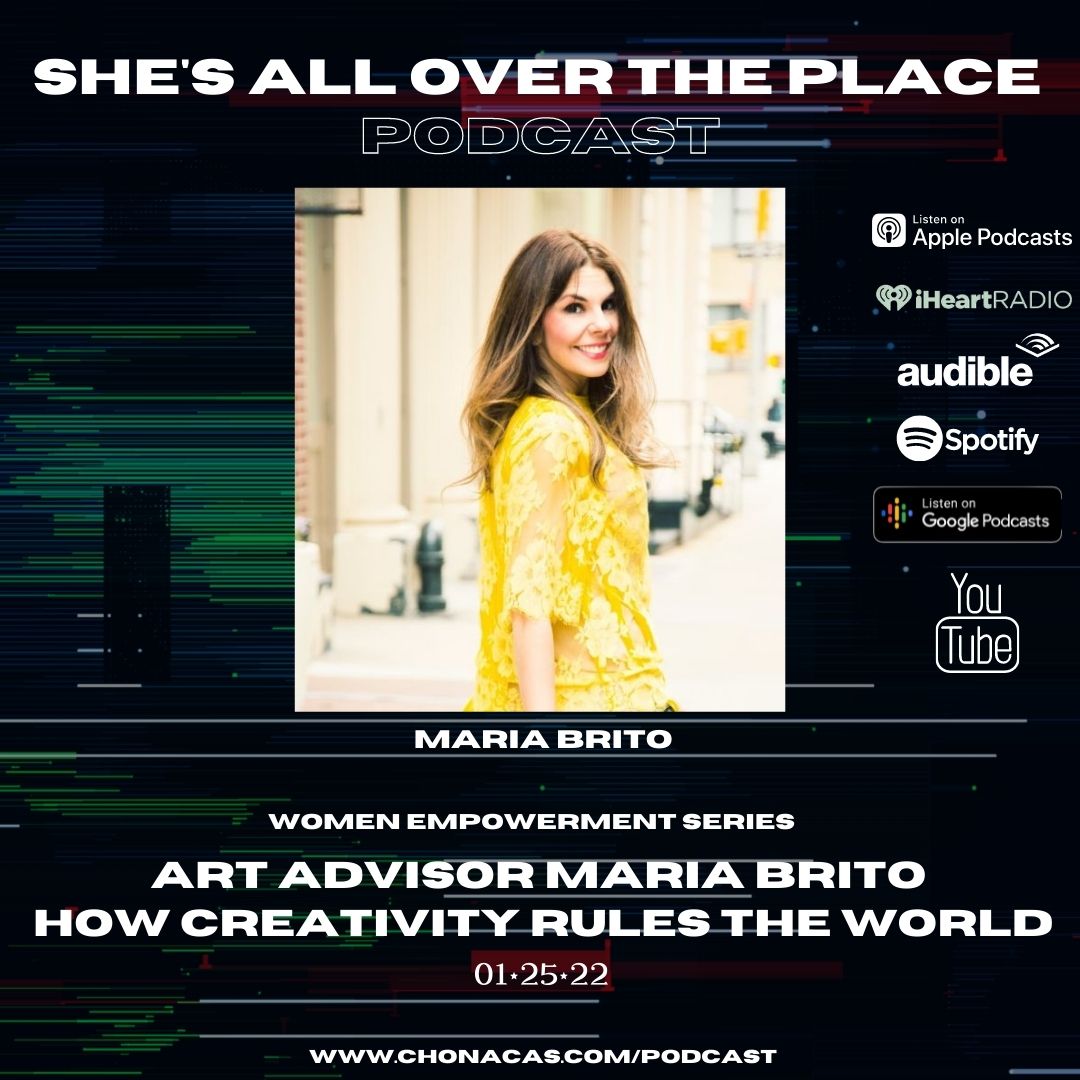
So with no further ado, Maria, thank you so much for joining me. And you gave him so happy to be here with you finally. Yes, finally. So great news. We just got the announcement about a couple of weeks ago from this platform out of all podcasts for arts podcasts of 60 art podcast for 2021, she's all over the place as number 48. So congratulations. Thank you. It's such an honor to be here with you talking about my very favorite thing in the world. Art. I think everything is art. This piece of chairs are this microphone. Everything is just art. It's how we perceive it. And I want to know from you, what is art for you?
How do you perceive art? Let's go on an exploration. Well, actually I want to point out that I am not an artist. I'm an art advisor. And what I do is I build our collections for people and IQ rate them. And I became an art advisor after I was a corporate attorney and it was very miserable. That was not my calling ever since I was a child. I was actually an artist as a child. And that actually is one of those big things in my life that will probably haunt me forever, which is that I didn't pursue my passions because I had very strict parents growing up and very traditional and particularly my mother
And she was very adamant that I had to do something with my life. And I'm in her world being an artist was not part of that, right? So I went to law school. I graduated, I, I came to New York and I worked in big law firms for many years until I couldn't do it anymore because I was really dying of sadness. And I opened my company 13 years ago and today's one of the most recognized that advisories and the country and actually in the world. And I'm very pleased to have been able to do that transition because now I can teach people how to do that for themselves and where to find the strength to change careers or to open up new paths for them.
And art for me is the definition of the ultimate definition of creativity because he has no boundaries and artists are not in any way, shape or manner bound by convention or by things of reality. And so I think that they are the ultimate future makers as well, because since they can see things that nobody else can or that nobody else imagine, and artists put them out there through whatever work, whatever medium they utilize is that means they can envision what most people cannot. So for me, art is the, the most transformative experience that any human being can partake off, no matter the medium, if it is a painting or if it is a movie or if it is a piece of a musical piece, anything like that is just the greatest and most beautiful and transformative power and, and moment that human beings have created in history.
Beautiful. And it's so wild because you said you were an artist and then you transitioned to art advisor. And for me, I still look at you being an artist as an art advisor. Like that is still an art form just from a different angle. Yeah. I mean your, your presence and your essence is just so beautiful and so colorful. And I just want to dive deep more into some stories. And so who are some of your favorite, I guess, all time artists and then some artists that you're really keen on in today's world? I think that, well, you know, the, always the question of today's artists is so complicated because I have so many and many, many, many, many, right. But I think that when you look back in history, there are people who have really impressed me and I admire them, how hard the work and the things they did.
And like you noticed that being, she's one of them for being the ultimate inventor, entrepreneur and master of mystery and curiosity and hard work and perseverance. And so I love him. I also love Picasso because he was prolific and intense and he, I mean, he's so criticized because of the women and this and that, but he never really, he never said you're getting an Angele or you're getting this sane. He was very clear about who he was and how he was coming. And what I admired about Costco is the intensity with which he worked, the work ethics that he had and the style that he created and how incredible he was each time each turn, the, you know, he was, he never was tired or, you know, bored or complaining about his life.
He never said no today, no, I'm not doing that. Really. Do I have to do that? That kind of like, you know, millennial Antech, I know he never did that. And so I love big fan of his life and his, and he's really, he like the way that the influenced the art world and the world that large through cubism is something that no other artist has done. And probably nobody else will. I mean, it'll, we'll have all their influences, but they, they will be different. Right. And I think that in, I mean, there are so many other amazing artists that I could talk to you for the whole day, but I think that contemporary space, I mean, there are so many incredible artists, you know, that for so long, we're not really named or talked about in the mainstream.
I mean, there is like and their EAs Mina Chanel lab name, and there is Kara Walker and, you know, all those strong black women artists who are now being collected by the MoMA and the Guggenheim, and they are having international shows that are spectacular and they have something to say, but is relevant and that is important. And the message is deep. So I I've always been a huge proponent and fan of black artists, not just now, because it seems that people think is fashionable. I've always been very, I've always felt very strong about their work. And in fact, for the past 13 years that I've had this business, I've put them in the collections of most of my clients, because I think that they were the underdogs and now they are the darlings.
And so it's very interesting to see how the market and has changed in the art world for many, many years did not pay attention to them. And now they are just dying to have them. Yeah. I love everything you're saying, thank you so much for sharing your wisdom, which leads me to being an art advisor now in the 21st century, what does that mean? How does it look and how, what are you looking for as an art advisor? So let's break that down, but what is the role of an art advisor for you in the 21st century and looking for? Well, listen, I'm in the role of advocacy because I advocate on behalf of the artists. And, but I almost put, I worked for my clients, right?
Who are the collectors? And it's like, it's a lot of navigating this fine line between you're championing an artists and a gallery or a certain program or whatever. And, but you're also mindful of the interest of your clients and what they want and their tastes is. And you want to protect their investments too, because although my clients mostly collect for pleasure and because they really love art and they want to live with art there, I have also responsibility to place things in their collection that I know that are going to retain value if not increase value, but he's retained it. So there is a lot of being an advisory is a little bit like being a financial advisor, but you have all the aesthetic components, the messaging, the background, it's a business of relationship because it just, the art market grew, grew and grew so much that it's, you've got to have all this very solid relationships with galleries and demonstrate that you're serious because since the demand is much bigger than the supply of art that people can't get right now from this galleries, et cetera, it only takes, you know, a handful of like people who can actually go when they want.
And so that means you've got to have your hand in a million different places and your eyes in a different, in a million different places to be able to also advocate for your client. Cause like at the end of the day, you have to build a case, why would your client be the best person to own this super competent painting? And so I have to feel all the cases for my, for my clients, but yes, I'm in the business of advocacy with anesthetics and with relationships and believe it or not, when I started this business, nobody really understood very well. What I was doing and now is so fun. Maybe guess like I run into young girls and they're like, you inspired me to become an advisor.
And so I think that's cute because it was not really like a job. And people thought it was like, you know, what is she doing to say that it's a re it's a full-time job. It is very busy, great pioneer in this area. So what are some basic building blocks for someone wanting to start? What are some like maybe ethics, morals, and values know thyself, what are some basic baseline things for someone who wants to go into the direction because you need to be an Oak tree or else you're going to be swayed every which way. And then, you know, there's a faith and the hope and the, the, the, the illusion, but how do we check in with other humans? And, and what can we do to have a basic solid foundation, follow someone like you, you know, do this, don't do this.
What are some basic things that one can do to want to deep dive into the art world of being an adviser? Yeah, I think it, first of all, is really important to be a solid relationships with the galleries because they are the gatekeepers of this inventory, if you will. And if you do not respect our rules, generally when you buy an artwork, you just cannot go and flip it at option the next day. Right? And so we have seen a lot of this. Like there are groups of people doing a lot of chats on WhatsApp and whatever on, they have groups on, on the back, you know, on the DMS of, of Instagram and, and start up. Sometimes they pull resources together and they buy something that is kind of like a little bit, like they couldn't buy individually, they buy it.
And then, you know, a month after he shows up at Sotheby's or Gracie's or whatever, because they know that particular artist is hot. And so that actually any laser chances to buy something else again, from that particular gallery, the people figure out ways of doing it. Right. So I think that to do the jobs that I do and be taken seriously, you have to make sure that you vet your clients really well. And don't just go with someone because they are offering you this and this and that. I think you are the one who sets the parameters, right? As a business owner, you want to work with people. We're very clear about your own rules and your own boundaries and your own parameters, but you also have to know them. And I think that the only time in my life, in this 13 years, that I have been kind of hurt backline is because I needed to pay attention to my intuition because I knew that line wasn't right.
And I still went without, luckily it was like 12 years ago. So the damage was done, but it wasn't as severe as it would have been later. Right. Because now I have more experiences. So I think that people want to do this job have too bad attention to their intuition. Be very well versed in the art of making friends with these galleries and keep the relationship alive with them and being nice and kind, which is, I mean, it sounds like the, of course, but you know, people are not nice and kind that much anymore. So especially if in the throws of the spins, I make a lot of people have lost their social skills, if not, because they were not that social before, you know, and then suddenly you're in this kind of mess, right.
Where you don't have, you're not interacting with people in real life as much. So, and, and I think that, that the, the other skill that is very valuable is to Regal the extra mile in the learning phase. Right? I mean, if you know that you're going to have to check 50 exhibitions in New York city, don't go to, sparity go to 50. You know what I mean? And like, if you need to learn and then you need to read and supplement, one of the things that actually shocks me the most in today's world is that the bar is so low because people are so lazy and they just are winging it. Right. So if you do extra effort, you're going to shine.
And the good news is that the extra effort, if you're passionate about what you're doing, which I'm assuming you are, because being an art advisor is amazing. And he pays really well, if you're good at it, but you've gotta love what you're doing, right. I mean, it's, this is about looking at art all day long and in silly. And so you have to have the skills of like looking at are they long sifting through all the things that are good and bad, and being able to convince your clients that what you're selling them is good. And so that comes with trust and time and putting that extra effort that I'm telling you, because sometimes, you know, I mean, I live in New York city, sometimes it's 30 or 20 degrees outside.
I don't want to go to the gallery, but guess what, it's my job. And I'm going to have to do it, you know, because I want to give my clients the extra effort that I went there. I, it, in person, I met with the galleries I met with the artists I saw at turning it upside down and I want to be able to give that to my clients. So I think that's kind of in a nutshell. Yeah. And then, so I mean, now with your successful career, who you are, you get invitations for this opening, come here, go here. And everything's cheer rated for you woven through, but you built it from the ground up. So I don't know if it's happening right now because of the what's been going on in the world. But for years, it's just Thursday, the galleries opened their doors and you're like a kid in a candy store, like free wine and just jumping around, meeting all the artists and seeing all the beautiful, cool art and meeting people in the scene.
So is that happening right now? Because of what's going on with yeah, it is, but it's almost like once a month or once every three weeks and people go, I don't, I don't think there's that much fun wine anymore. I think it's just people go from one gallery to the next, to see, you know, the new exhibitions and to mingle and to see the artists. And yes, it is. I mean, you know, New York has gotten a really high level of immunization and people are excited to be back on the streets and go out. I mean, perhaps certain galleries are rotating their shows with less frequencies. If they did it, let's say five weeks.
Now they are maybe extending it to six or eight and things like that. But yes, there are openings happening everywhere in Manhattan. It's a great thing to have that back in the illusion, someone might be thinking, would they see someone like you they're doing that? Or would you go during the day, do you stay away from kind of like the public mass crowds? Or do you still sometimes go and show up in network in those settings? Oh boy, the crowds, because then I cannot see. Right. So, I mean, that's the thing, right? If I am not able to see what the space and whatnot, I mean, I, the only reason at what I, why I would go at night and you know, like the openings are usually from six to eight is because the artist is a friend of mine and I want to be there and I want to be celebrating with the artists and I want to show up and say, I came, you know, so, but I'm usually there early during the day or the day before, if the show is installed because I'm doing my job.
And so I also don't know, but if you, I don't know if, you know, but 90% of those shows are already sold because everything happens with a PDF that gets sent. Right? And so this is how this whole craze, the demand supply dynamic that I was talking to you before has grown exponentially, because it's so easy to set up a PDF and it's a whole lot more efficient than bringing into your people. Right? And so my clients don't need to go see anything in versa. I do it because I'll want to see them in person. Right. But they don't even have to do that because they trust that if I send them a PDF or a JPEG or a painting or a sculpture is actually what I'm saying is, you know, JPEGs and the 21st century, I've been in heavily involved in the NFC space since 2018.
And I personally released my first NFC in March when I released my poetry book. I love her fairytale. And I definitely want to dive deep into your book and, and talk about JPEGs. And if T's non fungible tokens and how you are with the space of the galleries, what you're talking about, the galleries and how, you know, for people who are learning and if T's is a way for artists to take power back. And so instead of a gallery, getting a percent, they get the percent, every time it's sold and then you can do unlockables and stuff. And so how do you feel with that and how are you shape-shifting in the 21st century of NFTs in the art space?
I think that RFDS are what are the most revolutionary and pivotal moments in our history, because of all the reasons you said and artists having control of for the owners, how much money they're going to get every time it gets sold. And also the idea of having a metaverse coming up and the NFT, not just being a, an image, a flat image, but have, but that image has a lot of other functions or purposes. Once we are more into the metaverse space is absolutely fascinating and important. And it's important because we, I, or I particularly am always very interested in the future.
I don't want to stay where I am. I want to evolve with how the world is, or I want to be even ahead of the world. And I also think that the blockchain is going to allow for also authentication of tangible artworks and will help tremendously with traceability and also, you know, borrowing for museums and, you know, things like that, because it will lend so much transparency, hopefully to a system that is very opaque as it is and where there are really no way of finding who owns what and where he's at and, and things like that.
So it's not only just the digital aspect of, of the NFD, but he's also how an NFT accompanies a physical artwork and, and how much safety insecurity. And also what you said about adding royalties to that NFD. I'm not sure how is that going to be implemented, rolled out once it is always available for physical intangible piece of art? I'm not sure, but I think that it will give a lot more power to the artists. Like you said, I mean, it's not just going to benefit the gallery or the vehicle or the person who originally bought it. And I think the auction houses have done a tremendous job, and they're always ahead of the curve because the mandate of the, of the auction houses to make money.
And so they are always going to figure out how to do that galleries that are a little bit more conservative because they feel that they, and it's the truth is that they have different interests, the galleries, one to also protect the careers of the artists. So they don't want a little fast too soon because they don't want to crash and burn. Like they want to do that. So the auction houses have less of an interest if they crush number because they want, and they also don't care that much for the career of an artist, but they aren't happy to provide platforms and marketing and technology and things like that because that is at their disposal and they can do it. So I always say auction houses with a little bit of a, you know, it's like, I liked them and I don't because they also have created this monster.
Right. I mean, if auction houses wouldn't exist, we wouldn't have like, you know, $500 million, you know, Salvatore Monday by DaVinci that we don't even know if it was the Vinci who made it. Right. And so, and we wouldn't have all this young artists getting to like a million dollars when their career is like a three-year-old career. Right? So we are quick just for people who are tuning in name, some auction houses that come to the top of that. I mean the three big auction houses are Sotheby's Gracie's and Phillips is the smaller one of those three. And those are the most relevant right now. And the three of them are very involved with NFTs and, and Sotheby's just also released its own metaverse space for now.
It's just a screen. So, I mean, is that website, and what I'm saying is this flat is not something that yet feels like 3d or that we are immersed in it. But I think that they, they have all the technological advances that are bringing, you know, also to the future. And so my friend, Carlos Luna, James, he just did a collaboration with Sotheby's two weeks ago. He was on season three of the podcast. So anyone who wants to tune in and check out that episode, it was a really awesome episode talking about NFTs in the space. So thank you. And then, so will you, artists, you represent you'll maybe represent their physical piece, but then also the digital piece and then sell it to a collector.
And then maybe, I mean, everything's negotiable with art and in life. So maybe then someone says, oh, okay, I want to keep the physical, but I'm just going to sell the NFT. So maybe someone wants to keep the physical, but just the NFT can keep running. I mean, it is an option for people. I think that in the past couple of months or three months, Damon Hearst did something like that. But it was very interesting because he released a bunch of works on paper with dots that were accompanied by NFD, but he and the prices were really low for a Damien Hirst. I mean, it was not for free, but it was like 5,000, $10,000. I don't know. And then, but he made a, he made the buyers sign a contract where a year from now they have to choose if they want to keep the physical work or the NFT.
So this is a very interesting way to play with people. And David has always been incredible in a provocateur and an innovator. So I, so he actually, it's not exactly what you're saying, but it's a similar kind of play where he is saying, okay, what do you think it's worth more money? Do you want to keep the NFD? Or you want to keep the physical Damien Hirst dumps on, you know, on your, on your wall. So that is a gamble. And I think that, you know, maybe, maybe people bought two and they are going to keep one and in one paper, you know, I don't know, but I think it's, it's a cool way. But what you were saying is, is also going to be an interesting thing because, but he presents a problem with ownership rights, right?
Because one is okay, you have the physical painting and it's hanging on your living room and then somebody else has the NFT and they just have rights to blockchains. So it'll be something that will probably require jurisdiction. I mean, jurisprudence. So like, you know, judges will have to assess what's what, but for now it sounds so exciting and weird. And at the same time, kind of like the subject of scifi movies and things like that, because you imagine somebody is going to be like, trafficking the NFT and things like that, you know, who's gonna, who's gonna make the rules and like right. The lab too can go. Right?
Yeah. Super, super, super exciting. I think the space is just a lot of fun. So let's talk about your new book. Yes, please. How long did it take you to write it? And, well, it took me, I think like, almost like my life I say, right. But I, it took me about a year and a half to write it. And it's coming out in March, March 15th, 2022 is published by Harper Collins and this whole, how creativity rules the world. And it's a deep dive in to art history, entrepreneurship, business, psychology, science, data intuition.
And I think it's my best work so far. Really. I'm so proud of that book. And it is a manual for life. I want the people who get this book to refer to it time and time again, because it's not just something else. The moment is a book where I give my best strategies to keep my business relevant. I give all my and I match all this same skills to points in history where artists have done the same orange Norris ranging from Steve jobs to shun the rhymes, have the same skillsets. So I think it's kind of like, yeah.
And I think it's very important. That one thing is we do have to really end the myths of disturbing artists, because I know so many artists I've worked with more than 450 artists in different capacities. Right. I mean, they, they have done permissions for my clients. I have done fashion accessories with many of them in collaboration. We have a as interviewed them for, you know, TV like written about them in magazines and newspapers. So I know artists for sure. And I would say like 80% of the artists that I know are very well off and they are not crying and they are not like rolling around saying to starving artist. They don't even consider that term.
Right. And so it's an occupational, like any other I know, starving lawyers I do. And I do know starving fashion designers because they are not that great. Or they don't have them in tell them maybe they are, but they don't have the mentality that you don't have to feel dirty about money or making money or say, I don't know anything about money and that's not my mindset. I think that if you're good at something, you should be compensated for it. And so this book merges the worlds of business and art, and it's equally good for an entrepreneur or for an artist because it comes from all those angles. And the connecting blue of everything is I have everything backed up by science.
So all the psychologists who have, you know, battered information and analyze data and come up with a study that says, you know, this is what needs people need to be creative, or this is what people need to see the future of this. So I've gathered all those studies and connected them to both the business and the artistic part. So people have like a buffer in the middle say, well, I'm a business person. I don't believe this. Or I'm an artist. I don't believe this, but Hey, here in the middle, there is all of this science that is actually proving that what she's claiming in that book is true. So I also make a difference in my readers.
I hope that they can turn their ideas into gold and manifest and materialize things and never stay stuck, where they are. That's really also the point of the book I gave so many strategies. It has 25 chapters that are rich, rich with history and information. And, you know, I just have a desire to leave this world in a better shape than how I found it when I can. I mean, you're speaking my language, it's the same, same the fundamentals, the baseline, the mechanics, the foundations to connect and bridge. So people understand and make you a great impact. Thank you for that. I appreciate you so much.
And is it available on audio too for people? Yes. So there will be an audio book. I mean, if you come to my website, Maria, brita.com, there will be a page with a book that has, I'm going to be reused in bonuses throughout the pre-orders. So come and come often and check because I will give all those free bonuses for people who come and buy the book and present a, you know, a copy of the receipt or, or a screenshot of the receipt. So it's going to be an anywhere where books are sold from Amazon to Barnes and noble, to, you know, all the independent stores that are still very important. They are very important to me. I grew up going to oldest independent stores.
So it's very, very important that we support them and there's going to be an audio book also. So there's going to be hardcover e-book and audio. So we have all formats. Great. And then will you be reading the audio book yes. With your lovely voice. Amazing. It's so good. So good. And then, yeah, of course, all the social media links and the links for the book and everything will be in the show notes for, you know, the person tuning in. We'll make sure those links are there for you. Oh yeah, definitely. And then I just kinda like want to reset and kind of go deeper.
And is there something that comes to your heart and soul to share with the struggling artist in addition to, you know, receiving your book, but is there a message to artists out there who can make an impact take more actionable steps for their dreams, goals, and desires to make them rooted in reality? Yes. I think it's very important to be mindful of the here and now, and you're doing it for example, with participating off NFTs and doing things that belong to this moment. And I think that one thing is for any artists, who's listening to pay attention to that space and not be afraid of exploring it because I think although material things and physical things will never disappear.
I think it's very, very important to explore this right now because it's the right time. It's like, you know, it's the beginning of everything. Like the beginning of the internet was slow and it was weird and we had a dialogue and we didn't really know how to use it. So this is the beginning of that space of the NFTs. And I think that people have to at least experiment. I'm not saying, you know, just move on to that. I'm saying try. And another thing is to be in a position of power for themselves. I think that ever since Renaissance artists have never wielded so much power as they are doing right now. It is a very important profession that is highly reverted brands. Residue for artists.
Companies are looking for artists to help them redesign systems and to give them advice. And even the government is always looking for new ways to revamp certain things. And they're listening to what artists have to say so good. It doesn't do anybody good to look at yourself like less than, or that you are not important or not contributing enough or that you should have gone and done it. I mean, I think that once you are an artist, it's a vocation and once it's a vocation, it's something that you can't do anything else, but being an artist. And that's very powerful because it means that you're not a sellout, right?
It means like, it's not like I did, like I had to do what my mother wanted me to do. But I think that it's important for artists who are creating things where their hands it's almost impossible go by any day without creating something with your hands. Right. And I think that it's very beautiful and important, but also know that there is, there is economic power that there's true economic power in your hands. And you know, at the end of the day, you don't depend on anybody to produce things, right? You do, of course are in an ecosystem where you're going to need somebody to buy what you're producing. But I think that when you have that level of independence, that you can do whatever you want with your hands or produce or ride or film or youth started developing a lot of self-confidence.
And that's not something that anybody else in any other profession can because they will depend on many other factors and things to come together. But I think that when, once, you know, and understand the power of what it means to be an artist, you should capitalize on it to begin with. And also not struggle that much. I mean, I'm not, it's not that I'm not empathetic to people's struggles and positions where they are not making the money that they want, or they're not getting the opportunities. I am empathetic of that. And, but it takes time and persistence and we live in the age of acceleration. So what it used to be a 50 year career span, this just sitting low right now is five.
So I want people to actually be very mindful of that, that it, you know, and also, you know, be honest too. I mean, I've had already Sunni come to me and say, you know, I'm not having this opportunity to business or, you know, and I said, because you're already there yet. It's not that it's not going to be, but it takes time. Maturity practice, man. That's the other thing you've gotta be, whatever you do dedicate yourself. It's about doing things is about hours and hours of developing your skill. And that takes time and it takes time and dedication and focus. You cannot be doing one thing. And at the same time, playing fortnight and listening to a podcast at the same time and, you know, drinking a beer is like way too much.
Right. And that takes away from that level of nuances and expertise at your work. So I think I've given you a few nuggets here of what I love it. I love it. I love it. I really do. And even the people who are artists, you know, cause I'm around artists my whole entire life as well. And they still have the struggle of someone saying that thing that you don't want to hear, you know, or the mom or the dad or someone, and to like cut the umbilical cord and not people please. And to truly not care what others think to be in your power, to be who you are and walk the life of an artist. Even when you're doing that, there's still going to be people.
We just have to be aware if we attune and listened to it or know to tune it out and keep listening to people like you and people who are going to be mentors, lead us in the good direction, who understand what you're saying? And it's important. Yes and no, it's like, it's sacred. It's very sacred. And to take it seriously as a business, as it's business, you know, art is a business it's like show business. It's not, I mean, it's show art, show art. Yeah. Let's show you the art. Let's see the art, but it's yeah, it's a business. And as an art advisor, I love all the value you're bringing. Thank you. I'm wrapping it up here. Like honing in. If people, you know, want to get in touch with you or show you their art and maybe get mentored by you.
I don't know if it, how people can contact you and show you their Instagram or, Hey, what do you think about my art and for any, do you ever, I mean, it's difficult because if it's someone you don't know and you say something that might hurt their feelings or they might pose in backlash. So it's, it's a fine line, but how can people in a safe space as people like you, like, can you look at the trajectory of where my art is and where it's going? Well, in my website, Maria, brita.com, B R I T o.com. And I have a form and I received messages, you know, all the time. And so if I feel intrigued, because I also, like you said, I don't want to hurt people's feelings. So when I see something that is not necessarily in my wheelhouse, it doesn't mean it's bad.
I'm saying it's not for me. I may not answer. And also remember, I mean, I work 12 hours a day, right? I mean, and I have kids to feed and a mortgage to pay the most expensive city in the world. So I don't necessarily have the time to answer every note and every message that comes my way, but not because I'm a bitch, but because I really I'm busy. Like most professionals are right. And I cannot, you know, sometimes I think for myself, if this guys knew how many of these they get, and like, sometimes they're like this long and complicated question, as I said, if they knew how many of these I get. And if I were to spend, you know, like my days writing that those answers and meaningful, important answers, then I will be never able to do my job and pay my bills and my kids.
Right. So I think that it's a shame that there's not a, a job that is for that. Right. I mean like that mentorship for artists, but also it's a difficult career thing because you would have to ask the artist to pay you. And they're always trying to, they have no money. So, you know, it's a very, it's a catch 22 thing, but I mean, yes, it's the forum is there. And if you want to reach out and I typically answer the ones that have caught my attention. So just, just going through this brain child, this thing, maybe someone's tuning in we'll listen, we'll start a community. Maybe there's already communities out there. Maybe people will start talking about that. Maybe there is a platform or maybe someone will create different platforms to make that happen.
That in-between, so it's not all or nothing. So there's that emotional support and questions along the way. Maybe that's what the start of this communication is more of that. Maybe it's not all on you, but maybe you're a vessel for it to be. So maybe it's sowing a seed for other people in your space, in the art world as a collective, to maybe make a community platform for that, for the desiring artists who maybe have insecure questions or something and, and don't have the budget, but it's more of a communal thing. I don't know. I think that, I think that's a great idea. So if anybody wants to start letting me know, and I'll give you some ideas, but I think that what we're up against is that we live in a world of automatic things and we live in a world of big communities and aggregation, right?
And when you have those questions that you could have as an artist, you need one human being to answer back to you, not a machine and Bangalore, not like, you know, so that's where the challenge is, is that, and also, I know that artists are never really satisfied with one answer. So there'll be another question. And there'll be another question, right? This is almost like being a therapist without being a therapist. And it used to be more art therapists. There's there should be a whole category for artists who see therapists. That's funny. Yeah. Well, this has been a very, very fun chat and please let everyone know, you know, one last time, any ways that they can plug in with you and they will be in the showdown.
Yes. It's Maria brita.com. Maria S it sounds B as in boy, R as in rose, I, as in island, T as in Tom O wonderful. Congratulations on your new book. I look forward to being with you a one-on-one in New York city in the near future. I'm looking for that. Cool. Thank you, Maria. Everyone. Thank you for tuning into she's all over the place, and we'll see you next week with another powerful conversation about the divine femininity women empowerment and how we're taking actionable steps together. Thank you. Thank you so much for joining us. We'll see you next time,Kyriaki over and out.
Check out the She’s All Over The Place Podcast! https://www.chonacas.com/podcast/
Dreamland 1111 Album – https://distrokid.com/hyperfollow/saintkyriaki/dreamland-1111
Dreamland 1111 Merch – https://www.redbubble.com/shop/ap/93662139?asc=u
Saint Kyriaki – Miracles go to Marz (Official Music Video) – https://youtu.be/XjZDlwNU0Ac
Saint Kyriaki – Dreamland 1111 (Official Music Video) – https://youtu.be/9IjNGcgVCmI
Katie’s “A Lover’s Fairytale” poetry book on Love
Website: https://www.aloversfairytale.com
Buy the book: http://bit.ly/amzn-ALFTbook
Buy merch here: http://bit.ly/ALFT-merch
Katie Chonacas Socials
Tiktok: https://www.tiktok.com/@chonacas
Spotify: https://open.spotify.com/artist/2iTpKMr57KoIqdp92xLQb7?si=5Hi9uIcnSxe05XrpNtDL8w
LinkedIn: https://www.linkedin.com/in/katiechonacas/
Facebook: https://www.facebook.com/KyriakiChonacas
Instagram: https://www.instagram.com/chonacas/
Twitter: https://twitter.com/katiechonacas
Patreon: https://www.patreon.com/chonacas
Youtube: https://bit.ly/youtube-KatieChonacas
IMDB: https://imdb.to/3b2OQG3
OpenSea NFT Artist: https://opensea.io/chonacas