First, I would just like to give a shout out to myself, unconditional love art creativity for Valentine's. I did a drop on the hay layer, a marketplace. It's a women empowerment platform, and I am onboarding people to release their NFTs on Hilaire. I really believe in them and what they stand for and the collection, the Valentine's day love collection for the month of February is the rest of the images and poetry pieces from my poetry book titled the lover's fairytale. So definitely check out the links below and also you can see on the hay layer marketplace, my collection available for you for your heart through my heart.
And each description is on there giving the meaning and who I am and what I was growing through through that time in my life, my essence, my soul, my being so everyone who picks up an NFT also, I will send you a digital copy of the poetry book Oliver's fairytale. So I'm really excited about that. And also we're donating 20% of the whole collection to PETA and the gentle barn. Sadly, Robert Sterman, my dear friend lost his puppy and he's had dogs since I've known him since the beginning of early two thousands. And he's really into non-profits for animals.
And I have a passion for furry friends too, so, and homage and respect for the animals and the beautiful creations we've done together. We're going to be donating a percent to these nonprofits that we both believe in speaking of Robert, Robert Sterman is an international artists and he is the one who created this masterpiece, these artworks with the original Polaroid, which was discontinued by Polaroid in 2001. So they're very epic, super rare. And it's these beautiful polar writes from a moment in time of us curating together through the years. And then I coupled them with these poetry pieces that were written around the same time as well.
So I thought it was very apropos to couple the poetry with those images that you can see on a lover's fairytale poetry book, and then also own your own very MFT. Yay. Awesome. Awesome. Much unconditional love for you. If you want to know more about web three onboarding and if Ts definitely sign up for my mailing list, my head newsletters that go out also, I'm starting to focus on NFTs on Twitter or not Twitter. Yeah, I'm on Twitter too. Katie and I'm going to be doing a lot of videos on Tik TOK, which is Chinuch is my last name C H O N a C a S. So if you're on Tik TOK, go over there and just type in NFTs to learn more about NFTs as well.
And yeah, so moving right along this episode really touches my heart deeply and I want to shout out a project I'm really into is Astro emojis. You can definitely go to their website. It's Astro a S T R O M O J I S dot I L. And they're also on Twitter. If you want to meet up with them on Twitter, they're always having Twitter spaces. So if you're new to Twitter spaces, just go to Twitter. There's the four dots in the center, click on it, agree, and then go to your homepage and scroll to the top. And you'll see literally 24 hours a day spaces going on. And if you follow Asher emojis, you'll be, you can see, I believe they go live two or three times a week.
So they have doctors in there, psychotherapists psychiatrists, licensed therapists in the spaces. Psychologists, you can go on the stage and ask them questions. You can just listen and soak up the knowledge. It's so awesome because information maybe that you don't know that you're wondering about, you can ask, you know, and they can give you their professional advice, not from Google, not from what a friend or a family member says, but actually a trained licensed therapists. So the space is really great. They have a lot of utilities that are included that on their website, it's worth from 2000 to $5,000 that are included when you become an Astro emoji and F T collector, which I am.
They have a partnership with Wim Hoff. Do you know Wim Hoff, w I M H O F out of everything I've ever done, he has one of the best breathing techniques. You can type it in on YouTube. It's a 10 minute breathing technique that I need to apply and be consistent and do a lot more of it's us getting really, really into our bodies and out of our minds. And it's so healing, Astro emojis is all about mental health and wellness in the metaverse with mental health experts and practitioners. I'm really excited to be a part of their journey. Marvin is the artist who created these space helmets that are inspired by today, symbols of emotions and emojis. The character's mission is to explore their inner peace while they work on their self-awareness self-love and self development.
Definitely check out Asher emojis. They're going to be having mental health, wellness festivals, kind of like burning man meets, maybe lightening in a bottle,
Meet spiritual conferences and festivals that you can go to in the metaverse. Okay. That's my NFT news for this segment. And let's jump in with Paris, Paris. Thank you for joining me here.
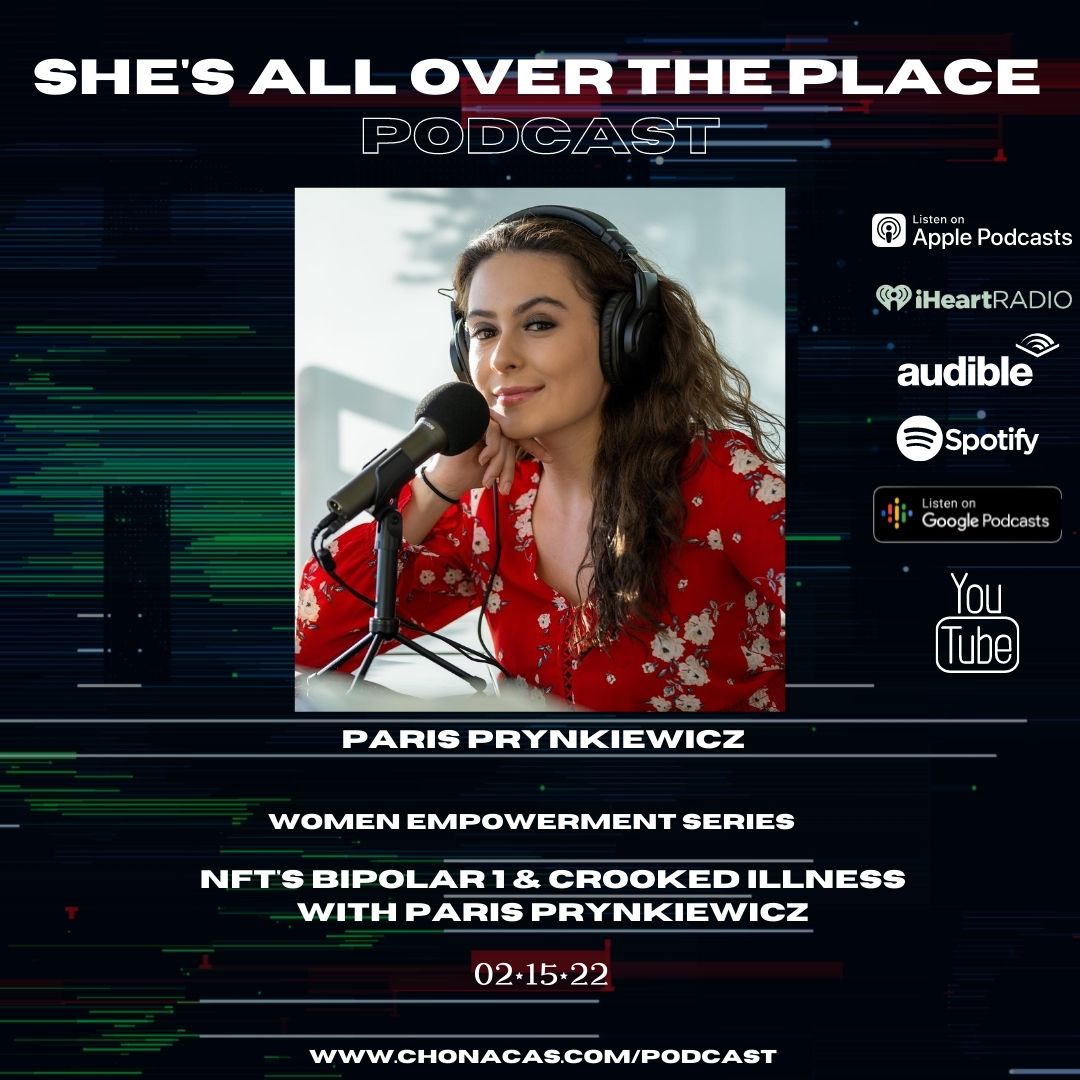
Of course, Katie, super excited to be here. I love, I love the last conversation we had on my podcast. You guys, I had her come out on my podcast, master your mental. We had such a great conversation, loved the energy, loved the connection. And I'm so glad to be here with you guys today to talk about the story within my book, that I released crooked illness lessons from inside and outside hospital walls. So, you know, that whole thing of going, and I have two main perspectives too, of going from being a patient 19 years old, diagnosed bipolar, suicidal, struggling from inside the walls of that psychiatric hospital. And then at 23 years old, I came out of college and I actually went back and I worked at the exact same clinic where I was a patient at.
So it was such an awesome experience to be able to be on both sides of that, and really take so many lessons away, even though it was definitely a challenge. And there were definitely very low moments for sure, but I always try my best to focus on the lessons and the solutions and the positive things, because that's what keeps us going, you know? Yeah.
Wow. We deep dive already. Ready? Thank you so much for sharing that. So openly you're true artists, definitely here to serve and add value for others. So, you know, in the time of the 21st century, you know, I did this thinking like, oh, women empowerment series. And I grew up, you know, looking in a man's world or looking, being taught, you know, as a businessman. So I'm like, let's do a women empowerment series, but I'm really gender fluid. I'm all about the divine femininity and divine femininity. Isn't just women. It's not just the gender divine femininity is, you know, within all genders. So how are you making it impact through your story tools? You've learned along the way where you can share and pave the way for other aspiring people out there for wanting to go out and just live life, but maybe they have mental struggles and circumstances as well.
I love that question. And I think the, one of the most important things to do is to first gain awareness of it, right? So gain awareness of having that struggle and then working towards solutions and what we can do to make it better. So one of the biggest things that has really transformed my life is gratitude, journaling and taking out a journal and writing out things that I'm grateful for and that I appreciate and experiences that I've had in my life that have brought me so much joy to really get my Headspace and my mind in such a good spot to start my day, instead of waking up and instantly going to the things that stress us out and are overwhelming and really getting in that zone. I like to shift that to make it more positive. And I actually created, it's a free 28 day journal data that I created for everybody.
So it's available. I have a Facebook group as well. So it's when you search free gratitude journal, everyone can get in there. I share motivational things to uplift everybody during the day and just try to help people, you know, see the, see the good in situations. Cause it can be so easy sometimes to get so taken aback and bogged down by things that are pulling us down. And we S we forget how to come out of that. So that for me, it has just definitely been that and also surrounding myself with things that really bring me joy and help me see the positives in being out here and just living life and being alive. So I always like to, you know, get around those kinds of people in those kinds of communities and just add value. And, you know, I also work with NAMI, which is the Nash national Alliance on mental illness.
I speak for them and, you know, share my story and the struggles that I face going from literally being a patient in a psychiatric hospital to coming out of that and really taking control back of my life, to just inspire people and show them that just be just because you struggled with your mental health on any kind of level, any kind of capacity, you can a hundred percent make it out of that. And I just love to pour into people and give them that because that's a gift that I wish I had when I was younger. For sure.
Really, you can just go to the dollar store and just get one of those notepads for a dollar. I mean, and just like have a joy journal, have a gratitude journal and have it in your car, have it in the trunk habit by your bedside. And no matter what, just like you don't have to be like, put a control of how much you should write, what you should write worrying about the grammar, just pick up the book and start writing from the heart. They say, when you write actually with a pen or a pencil, it connects through the nerves of your heart. So it's better than actually typing. But if you, if you're not good at typing or like writing, you can even do voice memos and just say your gratitudes in the language out loud, or the energetic shift in vibration and what we focus on, like pivot our attention to focus on.
So I love all that. Those are great empowering tools. I appreciate sharing you sharing that. And you know, me also elaborating a little more so in case we're in the imposter syndrome of how that should look, it's a canvas and we can decide how it's going to look, and we might not know, but we need to take one step in front of the other and make it happen. Yeah.
I love that so much. And just touching on what you said, you know, just starting more of these conversations like this, like having more of these conversations and, you know, being more, getting around people that you feel comfortable sharing your story with and sharing your experiences with. Because, you know, for me, I found that's the biggest way to shatter the stigma is getting in front of, you know, having more conversations with people and talking about the things that you went through and connecting on that level with someone else and being able to form that connection and that bond, instead of feeling alone and feeling isolated and feeling like you can't talk about these things, or you can't share these things because that's a great way to do it. It's just like just what we're doing right now, having more of these conversations and talking about these things.
For sure.
Yeah. So I want to pivot to the institutions and put on a prescription medication and you are a kid, you were a teenager. So your, your circumstances, what was it for you where you needed to be like, oh, I need to see a doctor. Who'd you talk to? And like, how did that happen? And there's so many different kinds of medications. Like, how did you, did you test them out? How did you decide to take the medication? Like, cause I know a lot of people are scared to take medication. It deteriorates your organs. It just does a lot of damage and causes a lot of other things to be taking more medications. However, medication really does help a lot of people as well. I heard and it really helps people.
It it's a very scary thing. So that's one of the, one of the reasons why I really wanted to have you on. So you can share those experiences of those deep, dark, gloomy places of you being scared and how that was for you. And how was your voice heard and, and what were you invisible? Like how did you feel? Just kind of like anything that comes at you, please let us know.
I love that. So for me, you know, what, what happened with me was I was actually first diagnosed when I was 16 with depression. And then at 19, when I was hospitalized, when I got the diagnosis of bipolar one. So I initially was thinking, I'm like, this is a misdiagnosis, but it wasn't because I didn't have that period of mania until I was 19. I was literally in depression from 15, 16, 17, and then started at 1819 having the ma having the manic episodes. But, and also when you talk about medications, I was on, you know, a lot of different medications being younger for depression. And then I finally, after I left the hospital, I was put on one, I've been on that medication ever since. And that's the only one that I take and it really works.
And one, is
It, do you mind?
Yes. Lithium. So I'm on that one and I've been on that one for, since I was 19 years old, but you know, going back to your point, it was definitely a very scary time for sure.
I heard the lithium is very strong. Like people say things about Lithia. I know some people who are on lithium, but oh, like I was told by people, oh, like, you know, don't take, I don't take any prescription medications, but you know, when I was like seeking out different things, people were like, oh no, don't take that one. So what are, what was the conversation with you? Cause it works for you. So
That's an important thing to remember too, is like certain medications, like debt, like definitely do not work for certain people and they have really bad reactions and things like that. So, and it is, it is kind of like a scary journey to not know. And especially when you you're diagnosed with the wrong thing, right. When you think, okay, I have I'm dealing with this and then you don't. And it's like kinda like this period of just confusion and frustration and not knowing what to do or what's going on with that. So for me was definitely for sure, really, really scary. And in the beginning of not really knowing where I was and just in terms of the medication and things like that, but, you know, it's really been able to help me just be able to stay stable and in a good place and to really continue to stay consistent with self care.
Right. And taking care of myself and prioritizing my mental health. So I know a lot of people do different things. So what do you do to take care of yourself? Right. So get up, move your body dance, get to the gym. You know, like we talked about gratitude, journaling, also meditation, yoga, just being present and then doing all that stuff. But definitely going back to the hospital for sure was one of the absolute, most terrifying experiences. Because for me, in my situation, it was very hard to focus on myself and healing and getting better when you're in a situation where so many people are struggling and just fighting and there's violence, things being thrown and you get scared. And I felt like I was almost in kind of like survival mode with trying to like take care of myself that I really didn't get to work on myself until after when I came home.
And I decided, you know, after seeing all the stuff that I did inside that hospital, I decided, you know, I could either continue living my life, neglecting my mental health, putting myself in situations where I'm hurting myself. I'm not doing anything to pour into myself or I can take a step back and I can make changes and I can do things that bring me joy and help me pour into myself rather than take out of me and keep me in that bad place. So
Where you were being, I'm throwing the word reckless there, but what were you doing? Not love yourself? What, what habits were you doing that were dismantling you from taking care of yourself? What were you doing?
Yeah, so what I was doing is I was basically just trying to escape from dealing with the traumas that I faced. So I wasn't ready to talk about that or discuss that with anyone at all. What I was doing was basically running away. Right. So I would, I was always spending a lot of time going out, you know, let's drink, let's go to the clubs, whatever, and just having a lot of sex and things like that. And just using that as, as something that I felt like I could cling to and just kind of distract myself from reality, but it was actually just hurting me, hurting myself more because I was actually felt like I was numbing myself in a way, all past feeling.
So many people do it. Of course I can identify in different ways. I traveled the world. I have a podcast called she's all over the place. Like the very thing I did was just run so fast and keep on going to be distracted and so busy and to see all the beauty in the world. So I didn't have to deal with the pain I felt inside. And I was also excited about to see what was out in the world, but it was definitely a way to run, like you said, and people have different escape ways to do it. And so being on medication now, how is it for you? Cause people are into psilocybin, shrooms. Like, are you into those kinds of things? Like, I mean, obviously you have a doctor and you're very privileged and lucky to have doctors and professionals to listen to. And it's better not to go to Google and not listen, you know, take advice from us.
We're not giving advice. We're just sharing stories here. And obviously the doctors are the trained professionals that we go to, but you know, to be hooked up to the, when you were 16 and 19 and be like emotionally supported with doctors, you have to have some kind of support system. So thank God you had that. And then, you know, so I just know in the times of youth and where we are, a lot of people are doing alternative plant medicines and things, and I'm very much into psilocybin and stuff like that. So like I would always just be scared and I've listened to so many podcasts that are like four or five hours long about like, oh, if you're taking prescription medicine, you know, you have to be careful if you're going to do anything like that.
So do you, are you tapped into any of those areas?
So honestly like for me, like I, since ever since I came home from the hospital and like 19, I've been doing this, I haven't had, I've just been staying consistent, you know? Cause I found something that works for me. And I think that's the important part is once you find something that works for you, right. To continue that, to stay consistent with it and to keep going with it, because I think the hard part is when you get, you know, you get put on a medication or something that like doesn't work and makes you feel, you know, like either you're feeling so tired, so exhausted, so rundown and you're not feeling good at all. Then that's the hard part, you know, when you're kind of jumping around trying to figure out what works for you. So what I've been doing is just kind of remaining consistent with that. And I haven't, and I'm, I've been very lucky to not have run into any more barriers since that time, just because what I do now is I'm so aware of what I surround myself with and what I engage with.
And I don't go back to those patterns that I used to have that were really, really hurtful. And because I remember that, you know, I, that's what I think of, you know, I remember those times of, you know, when I was struggling and having suicidal thoughts and being suicidal and had such a young age and just knowing that, you know, if I want to be the person to, you know, help other people and lift other people up, then I need to keep, you know, doing this stuff for myself and pouring into myself so I can be able to be that person for others. So,
Oh, so sorry. You had suicidal thoughts and you went through that. It was a lot for years with the suicidal.
So yeah, so I talked so like being from 15, 16, 17, like all those years and just really struggling with that. And that's really why I wanted to talk about it, you know, to show people like the full and complete picture of what this looks like, you know, to struggle with this and, you know, deal with this stuff. And then what does the work look like to come out of it because were you depressed? So I actually, so I talk about this in the book of going through sexual assault and not want, not feeling able to talk about that or, you know, and then finally reaching a point, you know, in there B being able to work through that and unpack that and process that and heal from it and move forward with such a, such a gift and such a blessing.
But it took, it took me years to get there just because, you know, struggling with that. And then, you know, also kind of just, you know, growing up when, you know, growing up in an environment almost where you're told, you know, that, you know, you shouldn't talk about those things or it's, it's basically being told, you know, it's your fault that that happened to you. So like growing up in that was just, it was very hard. So I really had to, you know, pull myself out of that and really commit to what can I do to come out of this? You know, what can I do to take back control and just really have a good life instead of letting these thoughts completely overpower me and yeah, for sure it would definitely was not an easy thing at all. And I know a lot of people probably struggle with that and I've had that in their past and dealt with sexual assault, sexual abuse and kinds of traumas like that, that are very hard to talk about.
So yeah,
You know, my soul, my soul is just crying over here and you're so, so beautiful. And I love you so much. I love you too, literally, so gorgeous, like inside and out, like your skin, your flawless and, and, and you've been on medications since you were a kid. So, you know, like it's not going to deteriorate. And the stigmas of it's going to deteriorate and make you look horrible because you are the definition of someone who is embodied strength and who's taking care of themselves. And you're just so gorgeous. You're really beautiful. And I love you. And I really, truly, you know, we all have lessons in life to learn and they say, you know, we, before we come, we choose certain things that happen.
Even our traumatic experiences, which is, you know, I'm not in this conversation and not, not really logical for everyone to understand, but the courage and the strength that you have and the experience you chose to have here and, you know, the stuff you're unraveling and, you know, you're shifting the vibration to make an impact for others is so important and your voice needs to be heard by many. And it's just really struck a lot of chords. Like we all have different circumstances and stories, but I definitely identify with what you're talking about. And I think we all feel taken advantage in different ways. No matter on the spectrum of if it was a 1%, 5% or a hundred or a thousand percent, it doesn't matter.
Like abuse is abuse. Guilt is guilt feelings and emotions. They're all, you know, invalidation. I feel like a lot of people bury their stories because they know circumstances that are worse or the people, the abuser people are saying, Hey, like, oh, you didn't have it that bad, or blah, blah, blah. And they're brushing it under the rug or they're making excuses to justify, you know, your story and your emotions. So I feel all that. Thank you for sharing.
Of course. Yeah. And I, I relate so much to what you just said there, especially when you go through those things and have those experiences happen to you, if, you know, dealing with so much trauma and not knowing what to do with it, not knowing how to communicate, not knowing how to speak about it because you have those feelings like I did, of feeling helpless and stuck and trapped, and also blaming yourself, which is something that I definitely did for a long time blaming myself. And, you know, just trying to say, you know, well, this is my fault. This happened and it's on me. And just really like internalizing that was so damaging at such a young age, especially being so young. And you're like trying just to figure out yourself and your life, but that's really what the gift I like to give people is no matter what it is that you've experienced, you have value and your story is powerful.
And that's why I always encourage people to share their stories and share their experiences if they're comfortable doing that. And if they're ready to do that, because you never know who you're going to impact with your words or with the things that you're saying about something that is really hurt you or challenged you. And you have a perspective on that that can help somebody else who might be facing that, who might've had a similar thing happened, or maybe they know somebody who's struggling with something and you say something and they can take that message and give that to that person and say, Hey, you know, I heard this conversation, you know, with Paris and Katie and they were talking about this and here's something they said, and you know, maybe this is something that you could try or look into. And that's what I think is so beautiful
Into it. Paris and Katie, I like that. I love your name. It has a good ring to it. Paris and Katie. So Lee, what you just said is so important because it doesn't happen. It doesn't matter if it happened when it was a kid or even now like, like what matters is to get it out, get the story out because the beast grows deep deep with inside. The isolation makes it so feared and so cold and it makes us more numb and disconnected. So by being able to actually communicate it deep within the psyche to dismantle the stuff you're talking about is so important because a lot of people, you know, even myself, I'll be like, oh, well that happened when I was a kid. But, and so you just you'd make an excuse for it. And then five years ago by a decade goes by and you're like, yo, I'm, I'm carrying around this rock and I can't get rid of this rock.
And it's the thing that people can see and it's showing up in my work, but I, but I'm not carrying around this beast and that doesn't pay rent and it's making me struggle and it's holding me down. And so, you know, I had to learn to communicate and get those out and put my emotions and my needs first to let people know, like, it doesn't matter if, if I was, if I was a kid, this is what happened. And here it is. And it just, it just kind of breaks the barriers of a clarification of internal piece just by getting it out. It's so important to be heard. Okay,
Exactly. A hundred percent. I love that. You say that because like you said, regardless of when, you know, something took place, whether you were a kid, whether, you know, whatever it was, right. That's what I think is it's so important to be able to get to a place to where you can heal from that and have those conversations, because it can be very difficult and extremely hard to do that. If you've never done that, you know, if you've been struggling inside of yourself internally with these thoughts of, I don't know what to do with this, I want to talk, I want to move forward, but I don't think I can. I feel stuck. I feel trapped. I can't, you know, and just feeling that, but if you can get to a place to where you can talk to somebody or, or just get that out there and communicate and start that dialogue, you know, I promise you, like for sure things will start to unravel and open up and really brighten up because that's the thing that that's so important is you don't have to stay in that place forever.
You know, you don't have to stay and remain stuck in that time or that moment of something that has really impacted you and hurt you so much and kept you down. You know, there are so many things that we can do and just so many incredible resources out there and just how to help ourselves, you know, how to help ourselves through these times and just to have that support system, you know, just be aware of who you have around you, you know, have people who lift you up and support you and care for you and, you know, want the best for you, and really want to bring that out of you and just, you know, do things that bring you joy and, you know, make time for yourself and pour into yourself and just really do all that you can to really give yourself that love, because it can be so easy to hate yourself and turn against yourself and say, well, you know, I'm a bad person because this happened or I'm, I'm worthless or I'm alone, or all of these thoughts that we have that are so nasty and ugly about our own selves that we say about ourselves.
We can rewrite that story.
Yeah. Gab or Montay mat is amazing. You can binge them on YouTube. He has so many free things you can listen to, but he demystifies trauma and how we're all traumatized. And he talks about when we're a kid, I think around six years old, there's two choices we can do. And the number one choice that most of us do is we point the finger inside and we blame ourselves. So then I think it develops that character of that language of dismantling and abandoning ourselves and being mean to ourselves and inflicting the pain on ourselves. Because we think that we, we deserved it. And it was because of us that so-and-so in our situations being this way. It must be us. I might be the bad person. So yeah. Good bore Mateo is amazing.
And it's just, you kind of wrapped it up, but circling back in, I want to know, because all the things we're talking about, you know, gender fluid here and, you know, women, and what happens when you're young girls and in 21st century, their sex trafficking, there's still the power of the goddess, the deities, the Shakti's and us not understanding our divine femininity and, you know, the, the power struggle of sex and money and selling our dreams and goals. And there's all that confusion going on. But when you're a child and you're having those experiences and then growing up in Hollywood, there's a lot of, you know, young boys who are gay boys being taken advantage of what is a tool or something you would say to someone who's hearing this right now, it doesn't matter when it happened to them.
Like, what are some actionable steps that they can do if something happened to them or if something happens to them, what can they do? Like talk to someone, tell someone like who to tell, like, how do you find a safe space of like, to share that information? Like if you didn't do it for yourself, if you did let us know, but if you didn't, if you're looking back at little Paris, what could have you maybe done differently to shed light on it? So maybe you weren't living with it for so long. Yeah.
I love that. I think that's such a great perspective right there w what I would have done is what I actually did is, you know, eventually opening up to my dad about this and like having a conversation, but what I would say to that person, who's, who's dealing with this, or struggling with this, or in that moment is to have, if you have someone around you that you trust and that you love, and that you feel safe with open up to that person. Because for me, you know, doing that was really the beginning of, of trying to start to figure out how to move forward from that. Because before that, I wasn't doing that. I was just really keeping everything inside and what it was doing. It was just eating away at me. It was eating away at me, and it was making me feel even more stuck and even more trapped.
But when I finally was able say, you know, here's this thing that I went through and that happened to me. And then also, you know, if there is an option, I would definitely encourage people to do that as well. If that's an option and then opening up to people, close to you, that you have a relationship and a bond with know you well and letting them know what's going on, and then talking about that and getting it out there, and don't let it stay inside yourself and eat each you up for it. Because something that has impacted you and affected you, you know, it has nothing to do with you because when it really look at it, there's a lot of, you know, hurt. People, hurt people, right. We hear that all the time. And that's true. And what I would do too, is, you know, for me, when I was younger, you know, being in a lot of, you know, abusive relationships and things like that, you know, just now looking back, it's hard to relate or to connect to that now, because just trying to remember, you know, the way that I used to be, it is kind of hard sometimes to say, wow, like, you know, how did I let myself stay that way for so long?
You know, how did I let myself go back to these people who've hurt me over and over. How did I do that? Because now it's like, it's almost like when you start to do that work and you start to do the work on yourself, you really see your value and your worth, and you really see all that. So you have a really, really hard time, you know, with putting up with people who put you down and make you feel that. So, and that's a good thing because it's growth and that's amazing. So I would just tell those people just to, you know, what I did is read a lot of books, read a lot of books, get educated, and just on the topic of mental health and how to take care of your mental health, self care, or whatever topics of interest that you have that bring you joy, that you're into, just pour into more of that and get more of that and surround yourself with people who really want the best for you and bring out that best in you.
I love all, I love all that. Thank you. And like, not only in like intimate relationships, a partnership and partnership, but also with family too. I mean, you know, all that applies to family as well. I personally didn't have a boyfriend for nine years partner. I was celibate for seven years. And I know now by having this conversation, I'm like, wow. I was, you know, I've thought of different reasons why I've been celibate and reflected on it and what comes up right now. I was like, wow, I was probably celibate. So I didn't have to go through those bad relationships because I was, I was scared. I needed to protect myself. How could I trust another person? If I didn't even know I could trust myself. I had to completely trust myself first before I could trust another. But I would have been in reckless relationships.
I would have probably been in the hoops for seven years of bad relationships and bad things happening to me. So I decided to be with God and the universe and nature and not allow anyone into my soul, into me see intimacy. Cause I was scared. I was really petrified. And then lastly, I want to say on this topic is what you shared was amazing. Thank you. And I want to take it to another dynamic of people who maybe don't have a loving, trusted person they can talk to. And sometimes if you think you have a loving, trusted person, you know, we can all talk to, even if we have that person they're not trained professionals. So I think it's really important to tell a school counselor to actually call SVU, to call the police department. I think we need to actually reach out to officials and cause you know, like if you're a privilege and you're in therapy, that's one thing.
Okay, cool. Like by law they have to tell information, but if you're listening to this and you know, you tell a trusted source, but they don't know the law, they, they they're helping you in their best way. But then you're kind of putting them in a position where you're like telling them and it feels good, but also they're not going to be able to actually take action to help you. And we need actionable steps for solution for what has happened. So I definitely think we need to tell a school counselor and call an anonymous line or just call the local police station anonymously and let them know what happened and get hard facts about certain things. Because people are scared. They're scared. They don't want their name. They don't want to tell the person they think we'll come after them. They've been threatened that they'll be killed.
You just don't know. I mean, in this world, what people say and do, and people are so scared that they isolate and they don't say anything. And then this Trump
Bill. Yeah, no, a hundred percent. I totally agree with you. And that's what I really am so into is it's helping people prevent that trauma from continuing to build. Right? So, and like you said, you know, doing all these things and reaching out to these resources and reporting these things and doing all of that stuff and then to really be able to care for yourself and do that is so, so important because you know, that's something that I never had when I was younger. Cause I didn't think that I deserve that. You know, I didn't think that I was, you know, worthy of love or a lot of these things for so many years because you know, a lot of times when you go through traumatic things, you start to feel that way. You know, you start to get trapped in almost like, like I call the trauma trap, right? Where you get stuck by it.
And it's almost like this hurricane that just sucks you up and you can't get out of it. You're just spiraling and spiraling and spiraling. And you know, finally, you know, after reaching a point to where you discover, you know, you have this awareness and you're like, I can't do this anymore. I can't continue living this way. I need to do something different. And then that's what opens up that door to being able to try these new things that really impact your life in a positive way, like taking those steps and separating yourself right from those environments that hurt you and bring you down and just make things worse and separating yourself from those people that really do hurt you and don't want, don't want the best for you. And doing that is so important. And you know, I that's, what I want to give to people is just to help them through that and to help them be able to,
Yeah, I feel yeah, 1000, 1000, just two quick things here. I know you said earlier, but just for clarification in case anyone missed it because you were diagnosed with bipolar and I know there's different kinds of bipolar, so which, what specific bipolar do you do?
Bipolar one disorder. So there's bipolar two there's th there's sick lomania as well. And then also that side, but bipolar one is just kind of like more it's manic and then depressive and then bipolar two is hypomania and depression. So it's like more of a higher level of being manic. So yeah, so that was when I was 19 years old and
Yeah, and there's a, there's a, like a skitzo effective, which is like bipolar and schizophrenia. Cool, cool. I love all this wood. We dive deep right in. So where can people one find you and congratulations on your new book and where can people find your book? Cricket illness.
Yeah. Thank you. Yeah. So it's available on Amazon and you guys can connect with me on Instagram. It's master your mental. I always love meeting new friends. So feel free to give me a follow. We can connect and chat there and yeah, you can get the book it's linked in my bio at mastery, mental and Instagram, and this has been awesome. Thanks Katie.
My pleasure rock and roll Paris. Congratulations to you. Thanks so much for tuning into she's all over the place. Podcasts, go to dot com. Sign up for my email list. Pick up my new book, a lover's fairy tale and connect with Paris on all social media platforms and we'll tune in next week. Thanks so much. Thank you so much for joining us. We'll see you next time. Kyriaki, over and out.
Check out the She’s All Over The Place Podcast! https://www.chonacas.com/podcast/
Dreamland 1111 Album – https://distrokid.com/hyperfollow/saintkyriaki/dreamland-1111
Dreamland 1111 Merch – https://www.redbubble.com/shop/ap/93662139?asc=u
Saint Kyriaki – Miracles go to Marz (Official Music Video) – https://youtu.be/XjZDlwNU0Ac
Saint Kyriaki – Dreamland 1111 (Official Music Video) – https://youtu.be/9IjNGcgVCmI
Katie’s “A Lover’s Fairytale” poetry book on Love
Website: https://www.aloversfairytale.com
Buy the book: http://bit.ly/amzn-ALFTbook
Buy merch here: http://bit.ly/ALFT-merch
Katie Chonacas Socials
Tiktok: https://www.tiktok.com/@chonacas
Spotify: https://open.spotify.com/artist/2iTpKMr57KoIqdp92xLQb7?si=5Hi9uIcnSxe05XrpNtDL8w
LinkedIn: https://www.linkedin.com/in/katiechonacas/
Facebook: https://www.facebook.com/KyriakiChonacas
Instagram: https://www.instagram.com/chonacas/
Twitter: https://twitter.com/katiechonacas
Patreon: https://www.patreon.com/chonacas
Youtube: https://bit.ly/youtube-KatieChonacas
IMDB: https://imdb.to/3b2OQG3
OpenSea NFT Artist: https://opensea.io/chonacas