I'm on podcasts weekly, and I'm always, when people are asking about my upbringing and brushstrokes about who I am, I'm always sharing when I was a kid, I didn't know the language of HSP. I didn't know the language of empathy, but as I, you know, know now and I reflect back, I was an empath. I was an HSP, a highly sensitive person, 16 to 20% of the population have HSP.
And I particularly got turned on to HSP in 2014, where there was this book called HSP by this woman named Elaine. And I'm talking with Jen and she knows the book. And she found out about that book or another book called silent. And she'll tell you all about,
But before we jumped down that rabbit hole, I want to just tune into Tokyo punks and NFTs. I am so obsessed with NFTs, such a craze, such an awesome experience to be a part of it, all the community. And you know, the topic today of HSP and empathy goes hand in hand with the people in the community of NFTs, how to be ethical, the wonderful people in the space and you know, the nonprofits and also healthcare, which leads me to Ash Cooper Kerns since day one of meeting her on clubhouse. She was very deep in with nonprofits.
And recently she released a collection of our own of her photography for NFTs. You know, they were on Twitter spaces and favorite giving on Twitter and Kendra had hearts. It's kindred hearts IO on Twitter as well. I'm following them, they're following me. Awesome. They have a really cool project coming up. You can look at it in their discord. The presale is February 11th. So I just love the heart message of the project. And, you know, Ash was on and she was telling her stories and I was really moved by it.
So if you're wanting to get more involved with NFTs with nonprofits and you know, really good people from a heart community, I would definitely, you know, tune in with Ash on her Twitter handle and then kindred hearts. I O N also favorite giving, which is F a V R I T, giving G I V I N G. So definitely check out who they are. And so on the website, it says that their mission is to financially empower under resource communities and causes with art cryptocurrency and NFTs. They're driven by collective desire to affect positive social change through financial inclusion and empowerment ecosystem with heart.
The heart is the universal symbol of giving it's time for a system designed to empower my unkind and encourage giving. Cool love this. If FTS are definitely here to stay. So when, and if this resonates with you, definitely tune in and follow and connect with them more. Speaking of heart, Sabet pioneer legend in the space has me moved to tears. He just released Tokyo punks. They were on presale for two days and gratefully. I was on the presale list. The collection was under 5,000. Very affordable art is the utility love is the roadmap so passionate. So soulful so deep from a heart loving space.
Oh, is it just too much love for you? Or why? Seriously check out Tokyo punks. It will blow your mind. Well, it blew mine and it's just like, Paul just keeps blowing my mind. Just the colors are so vibrant and the message and everything is just so impactful and awesome. So that has healing codes coming out pretty soon. I think the exact date is February 28th and yes, I signed up for the presale list. There was only a limited of 2000. So yeah. Am I, if you want to know more about Sabet follow him on Twitter, S a B E T. He's also on Instagram. So kind so generous a leader.
I said in the space and yeah, he has a whole collection of projects. So there's like Sabet sales, which is his Twitter handle as well. So you can see all the different projects he's working on in the community. Shout out again to rug, radio for Rukh, love the platform over there. And I'm so excited to just learn more and keep vibing and creating and learning new things. So I like popped in really quick and there was this awesome woman on she's. A genius scientist, explore a space artist, poet and astronauts who recently became the first black female pilot of orbital spacecraft. Her name is astronaut Dr.
Simon Proctor and she has an exclusive Genesis NFT art collection with the going to space community going to space. Okay. So she has this really cool NFT. There's only a hundred pieces. I'm surprised there are some left. I'm surprised they're not gone already. It's really cool artwork. She's the first poet. She took her poetry to space. How cool is that? I'm a poet. So I'm in, I'm in love with the vibes. Okay. And then there's this also this guy, his name's Ryan S T U I T Ryan S T U I T. He's an award-winning filmmaker artist and musician with a passion for space. Wow. Sounds like we have a lot in common. I'm a filmmaker, I'm an artist.
I'm a musician. And I have a passion for space too. And he's half of the space music artists called test shot starfish. Wow. And I was listening to them nonstop on Spotify yesterday and the music is very cool. Check it out. So he's on the very short list of artists who have had their physical artwork flown in orbit his inspiration for physical painting and NFT sold as part of the mission fund raise after safely returning to earth. Wow, that's so cool. His newest collection of digital art, his Genesis collection debuting was at Miami art week in 2001. All right. So he has this digital composite of 3d astronauts converted to vector images with composite mixed media paints and papers.
The piece was originally created for an upcoming album release for the project test shot, starfish music for space. Okay. So it's really beautiful. You have to see, I became a collector. I just had to pick it up. I wanted, you know, both of them really astronaut Dr. Siam Proctor, her physical artwork also has their music in it. The music from test shot starfish. Anyhow. So that's the vibes. I think it's, there's only 50 available. It's limited edition. It's like a super cool collection. And like, again, I'm surprised they're not all gone already. I just think, I don't know. I I'm. I just think I'm just so grateful that I heard about it.
And I was able to collect, you know, they have this endless inspiration inspiration for St. Jude on September 15th, 2021, the crew of inspiration for blasted off from NASA's Kennedy space center on a space X Falcon, nine rocket officially beginning the age of civilian space flight. And listen, Spiration is a dynamic artwork incorporating advanced scientific imagery of this historic mission captured by tracking telescopes at NASA's Kennedy space center in Florida. So they're involved with St. Jude, definitely go to NFT dot, going to space.com. So you can collect your NFTs and read more about the project, if you're until a science in space.
Like I am so, okay. I just like completely deep dive there. I have so much more NFT goodies to share with you tune back in next week and let's dive into HSP and empathy
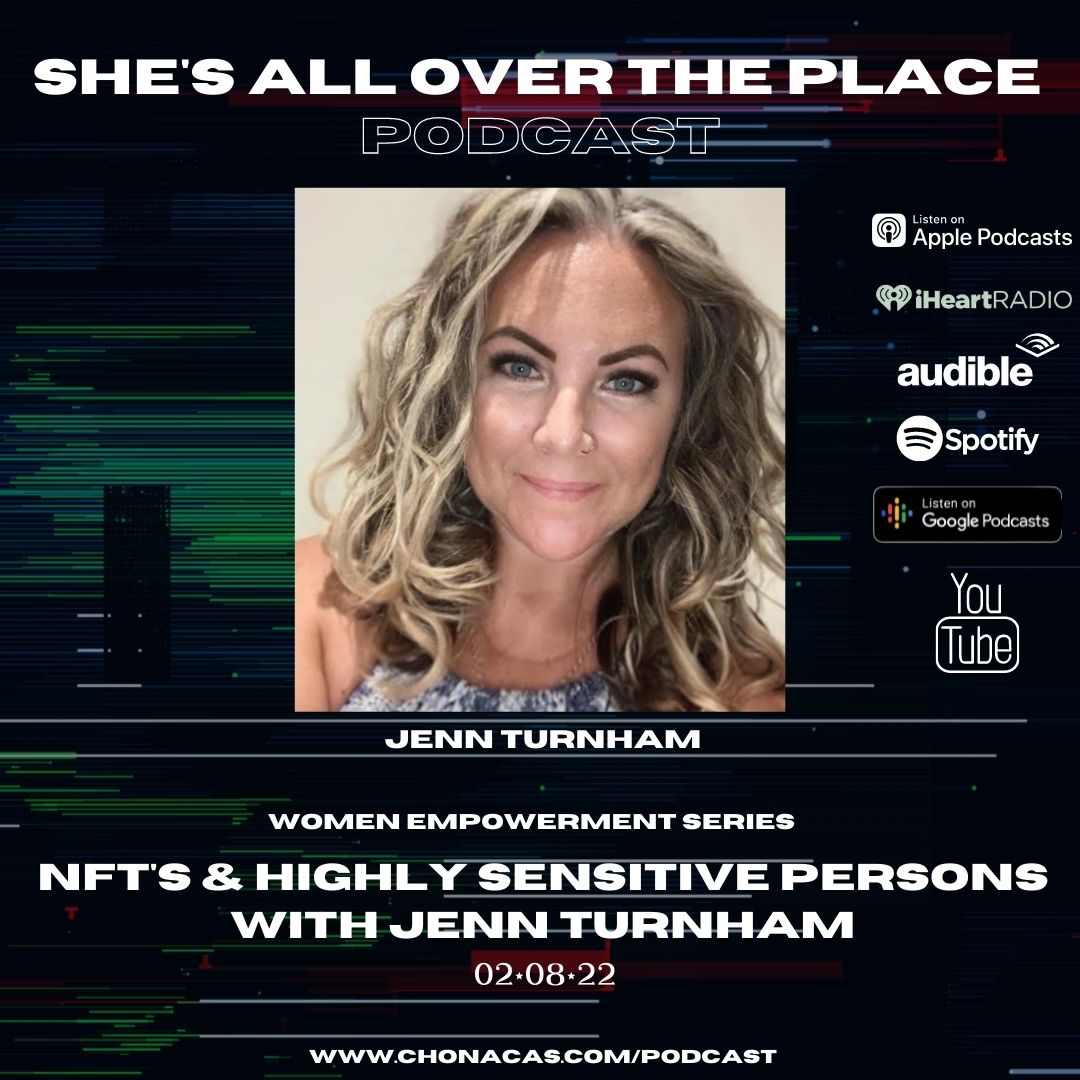
Further ado. Let's talk about being sensitive human beings and what it means, ambivert extrovert introvert, all of that jazz. So we're, you're in for a great episode today. It's I think it's going to be one of my personal favorites of the series. So Jen, how are you? I'm very well, thank you. I'm very honored to be on these podcasts. I thank you so much for having me, my pleasure, my pleasure, and anyone who wants to tune in to the YouTube, go to Katie Cienaga stuff on YouTube, and you can see the video of how gorgeous Jen is. She's in Australia with her beautiful blue eyes. Oh my gosh. So tell us about Jen. Where'd you grow up? How did you get involved in HSP?
What's your degree? And let's just start there.
Sounds good. Thanks. So I grew up in a relatively small town in Perth, Western Australia, it's focused suburb of Perth, and it was one of those places where it was really great to be a kid. So the kids used to play on the streets together. We used to ride our bikes everywhere, and it was the, I was very blessed to have a really stable, lovely upbringing. I was lucky to be born to the parents that I was born to. And then I, when I finished high school, I went to university and I got my bachelor of psychology to great. And then I went off and did a whole range of different things, which I won't go into now, cause that'll probably take up the whole episode. But in terms of when I came across HSP, I was quite, I suppose, late coming to it.
And a lot of my ladies, I find that it's not until they get into their forties or fifties, that they really kind of stumble across it. So I was given the book quiet by Susan Cain, by my dad. And he actually gave it to me to try and help me understand the introverts in my life because my dad's very introverted. My brother is too. My fiance is my fiance's dad. They're all very, very introverted. So dad gave me this book and said, Hey, this will help you understand us. And then I felt a little bit bad because I feel like I got more out of the book for me. It wasn't, it became about me rather than about them.
And that was because Susan Cain references, HSPs highly sensitive people. And I have never, I'd never heard it before. And I looked back on Elaine Aron's research and her research was being done around the time I finished my degree. So that's probably why it wasn't covered in my psychology degree. So then of course I, for me, that was the missing piece of the puzzle because having studied psychology, I've been fascinated by human behavior. I've kind of probably over-analyzed myself, my entire life. So of course I was fascinated to discover this. So I started looking into it. And for me, I've always known I was an extrovert cause that's quite obvious to most people, but I never felt like I really kind of fit.
I didn't really fit that extrovert mold. So then when I discovered HSP, I went, oh my gosh, it was like this light bulb moment that everything kind of finally fit together. And so when I discovered I was HSP extrovert, that made even more sense because the majority, you mentioned 15 to 20% of the population and HSPs all of that 15 to 20%, 70% of them are introverts, which means only 30% extrovert. So took me a while to figure out the maths on this, but it had to be about 6% of the population are highly sensitive extroverts. So it's very small percentage of the population. And at the time I'd already started my coaching business and I was looking for a niche.
So I thought this is perfect because I am one I'm really passionate about these women because the more I learn about them, the more I think they're so amazing. And they've got such gifts to offer the world. That's where I kind of started focusing really on highly sensitive extroverts. And that's where we, that's where we come to today. So that's, I've got a Facebook group full of amazing HSP extroverts. And now part of my mission is to get out in the world and educate the world about HSPs. So that's partly why, why I'm here doing this.
I love that. Thank you so much for being here and sharing. And we'll have all the links in the show notes for the Facebook group and how people can connect with you more, what a great community. And it's a specific niche, you know, and imagine all the people who don't know that they're HSP. I mean, those numbers can go up because there's so many people who don't know, you know, and it is a journey to find because I feel like we're taught to ignore our feelings. We're taught, you know, some of us are taught to ignore how we're feeling and not being in touch. So how can we explore being a highly sensitive person will we're taught not to, you know, feel those things. So that's, you know, that's just one stepping stone of, you know, uncovering that and, and trauma and dealing with different circumstances of, you know, mentioned earlier, you know, being a victim and everyone's stuck in their own muck.
And so how can you focus on the sensibilities that's happening within us when we're being so hard on ourselves internally and not giving ourselves a chance to actually feel, you know, without the feeling of guilt earlier, you were saying, oh, dah, dah, dah. And then I felt guilty, right? Like he felt guilty for putting yourself first. Right. So I think I can identify with that. Hopefully, you know, the person listening and watching can identify with what you're saying as well. Yeah.
Yeah. And I think another big thing, another big theme in HSPs lives is they actually grow up. Most of us grow up feeling like there's something wrong with us because we, we sense because one of the skills of being HSP is we're sensitive to subtlety. So we, we get this sense that we don't quite fit and then we don't quite belong. And that there's something a bit off about us compared to other people that obviously in itself causes a lot of challenges. And so a lot of the ladies that I meet, it's just such a, they say it's a blessing and a curse to discover that your HSP a blessing, because they finally feel like they found somewhere that they belong because it is a thing.
And it's not just that there is something wrong with them, but also a curse because it does come with its challenges. And what I'm really passionate about is helping HSPs focus on their strengths and kind of live into their amazingness as opposed to some of the challenges that do come with being HSB, because there are challenges and Elaine Aron talks about the reason we have challenges is not because there's anything wrong with us. It's just because our brains and our nervous systems are wired differently and society, we don't live in a society that is conducive to us flourishing. So we have to figure out a way to kind of navigate this crazy busy pressure cooker of society in order for us to then display our strengths, which can be challenging.
Yeah. So a few weeks ago I was on my tick tock. It's just my last name. and I something channeled through me and I did my first channel and I'm like, whoever needs to hear this, just so you know, nothing is wrong with you because I've gone my whole life thinking like, what's that wrong? One thing that's wrong with me. And I think I watched something with Katy Perry, like a couple of years ago, she was bawling and bawling. And it was that, that little girl. And she connected with her little girl and she had to like go back to like eight year old Katie or something to like hold her hand and like go through the journey. And I did that through Julia. Cameron's the artist's way, you know, to reconnect with your little child. And, you know, I just channeled something like, nothing's wrong with you? When I removed myself from family members, from people in my life where I thought I was like all or nothing anchored and hooked onto them, like I like a death threat.
Like I had to give my whole self to them instead of choosing myself first, when, before I chose myself first. So I knew what it was like, but then I was like, well, I'm going through this experience. And I'm like hooked in thinking I'm emotionally bonded to these people. And then allowing people to say what they want about me, you know, from now, and from when you're younger and then to dismantle what someone energetically saying about you and your we're playing ourselves so small to actually remove ourselves from that energy. And then you get to a homeostasis place where you're like intuned in balance with your left and right hemisphere. And you're connected. And you're just like whole you're 1000%. We're always home, but the, we were weighed down by other what other people think what's in our, what's in our psyche of what other people think or physically in an environment of, you know, being like underneath a rock.
So will we remove ourselves from that? And it's quite challenging because with me being how strong I am and intuitive of how I am and how powerful I am, I went through that journey and I went through that journey. So I could be here with you having this conversation to make an impact. So we can share that space with other people to show you how to remove yourself from that energy that you don't see. Like you can see a cell phone, you can see a laptop. Some people see energy, most people don't. But if you take one person, a hundred percent of energy, but then you take 50% of the energy and you put it somewhere else. Then you're going to know you have 50% energy on this project and 50% energy on that project. And then people can understand it fundamentally because a thought of energy turns into form, which turns into matter.
But when you're talking about one hour of talking to someone over here, but afterwards I feel depleted, exhausted. I have to go to sleep. So you're like, let me, instead of talking to them for one hour, let me talk to them for half the time, 30 minutes. And then that energy of that half the time you're restoring with oneself, when you're an HSP, you may need to be alone. I'll need to run my wrists. If I'm at a party under cold water, I found out through the years, I'll have to go to the bathroom and run cold water under my wrist, or put cool water on my face or behind my net. And because my energy centers are open. So I take on other people's energy. That's why a couple nights a week. I mean, I love sleeping alone. I love coddling, but a couple of times a night, a week I'll need to just sleep by myself just to reconnect with my own energy.
So HSP people have these sensibilities and other people who have got walls up and armor up, or they're numb, and they're not associated with their nervous system that you were saying they're detached from their own nervous system from ignoring it. How could they understand your sensibilities? If you don't understand yours and they don't understand their own. So there's all these disconnects. So we can be here now to kind of unpack some of this conversation.
Yeah. Yeah. And I think what you said about that guilt and that putting others first and putting ourselves last, that is a classic HSP challenge. And the guilt is a big one. So most of the HSP extroverts I talked to, they have been taken advantage of they've been walked all over. They've got plenty of toxic relationships in their lives. And it's because as you mentioned, we're so open and we're very others focused as well. So quite often we do come last in the list of priorities. And so one of the big things that I encourage all HSPs to do is to learn boundaries because particularly if HSPs grow up with a less than ideal childhood, the research shows that they end up more damaged than non HSPs in exact same situation.
That's due to what's called vantage sensitivity. And it sounds really sad. But then the flip side of that is our vantage sensitivity allows us to flourish more with positive interventions. So that's what I've noticed about my ladies is when they're doing personal development and personal growth, they're reaping the rewards of that. And I think boundaries is probably the first thing I would recommend people learn to.
I would like to say one thing about boundaries. One short example is for me, I'm in Los Angeles right now. And anytime I go out, which isn't all the time, but you know, a couple of times a week. And if I'm seeing anyone new and they're just enamored by me, they're just like, how old are you? How old are you? And I'm like, I'm powerful. I'm independent. Like, I'm okay with my age. Like, I'm going to tell you how old I am. Like I don't care. But other people are like, oh, don't tell people your age. Don't tell people your age. Well, I feel like it's lying and I'm emotionally attached to, oh, I feel guilty because I think it's lying. Then I feel guilty because like they can just Google me and find out like, or, and I also I'm like so attached to like meeting someone that connectivity age doesn't matter, the kinship of authenticity and truth.
Like, why would I lie about my age, but why do I even need to say my age? It's like, there's some, there's the boundary and there's a respect. So my friend who's very strong and very assertive and knows boundaries and is just like this powerful being recently taught me. He's just like, it's none of your business. Or why do you ask? Or like, you know, that's my personal boundaries. And so a couple of days later it happened and someone asked me it was last night and I'm just like, I go, why do you care? And it was like, literally. And then I just went to the table when I came back, that person just gave me off the newfound respect. You'll at first I felt like, like I was being like, roar, like a brace or something, but I walked away and I went to the bathroom and I just like chilled in the bathroom. I did like a Tik TOK video.
I liked it. I did like a creative video in the restaurant. I just let it breathe for a little bit. And I came back and when I sat down, I actually felt good about it and empowered. And I'm like, oh, wow. Yeah. And then the person at the end of the end of the table, like respected me and spoke to me in a new way. Also almost like not kissing my AWS or like kissing up to me, but kind of almost like paddling upwards to me because I put myself at such a level and I'm like, oh yeah, that's what my friend was talking about. And it felt so good because I don't need to be attached to the suffering. I don't need to be attached to the guilt. We do have attachment style, which I'll I'll, that's the second part. I want to talk about it in a minute, but you know, so when we first do it, it might seem bold. Like, look at me, I'm already a bold person, but in the way of what you're speaking about, of what we just talked about, that was bold for me.
I can do for other people. But when I do it for myself, my personal need is we all have resistances. And my personal point of resistance is personal need. I can take care of you, anyone on the street. And I can like, go run anyone down and be like, yo, you need to get this person this right now and I can make it happen. But when it comes to my own personal need, I always, I, in the past, I'm, shape-shifting my energy right now before I would always forget about myself and not take care of my personal needs and take care of everyone else. Now there's no way I'm leaving unless I'm taking care of, I won't abandon and leave myself behind. I used to do that. That was the old me and I won't, I cannot do that. I do not stand for that. I will not allow myself.
I have a baseline and I have a trampoline and I will not go through that, that limitless black hole and abandoned myself.
That's beautiful and so powerful. And I think just on the boundaries that you mentioned, one of the things that I think is like a revelation to women, because I teach boundaries in my free Facebook group, it's that we educate people how they can treat us. So what you were saying just then about you essentially educated that person that you deserve respect in that example. And I think when, when my ladies learn that when people learn that it's kind of, it shifts the energy around boundaries. Because as you say, most of us leave ourselves behind. HSPs have that tendency to leave ourselves behind, put ourselves last. And that's about shifting that energy and actually saying, well, if you don't educate people to treat you with love and to treat you with respect, some people won't, some people will walk all over.
You see,
Because they walk all over themselves. How are they going to respect you when people don't even respect themselves? Exactly. Yep. So we're actually doing other people a favor by telling them and sharing with them how to treat us actually we're raising the bar for them to exactly. Yep. Definitely love that. Love that. Yeah. Really, really beautiful. Really, really beautiful. The other thing you were mentioning besides boundaries, the other thing besides boundaries was you can talk about attachments, I think, is that each? Yeah. So you were explaining something of being in this hole and being attached to the suffering, but then they make the choice to empower and they make that choice. But then what happens is when we make the choice to empower and we make that choice, we need to become addicted to the empowering in that.
Because what happens is since we have addictive personalities, we it's like a drug and we'll be addicted to the suffering. And to the woo is me and to the cried pit circle, we're having the pity party where we like to revert back because we're used to that. And we want to be friend that part of ourselves. But the key is not to allow to be, be friend that part of ourselves, because it's a, it's quick sand and it's, there's no wind there, but because we have addictive personalities, we don't want to leave that part of ourselves, lone summits, a part of the suffering and Caroline mice, who's a mystic intuitive Caroline and S she says, you can be on the bottom, same building.
You can be at the bottom floor with pollution, taxi cabs, horns honking, rats, trash smelling, or you can be at the pet house with the Butler and caviar with the view of central park and everything's plush and served. And everything's delicious. Are you at the penthouse or are you on the bottom floor with the rats? So it's like the people who have less fortunate circumstances have it worse. And then the people who have trauma, who don't do their work are at the rat level and at the bottom floor with all that toxic stuff. But then the people who choose to understand they could be HSP, they could be an extrovert introvert. And when we choose to do the internal work and we choose to go to the other side, Caroline, Mike talks about having one foot in and one foot out.
And she's like, it's so mucky in the back and forth. Now I feel like in relationships, that's where a lot of times back and forth and relationships, we know we want to get out of the relationship, but we say, because of this reason, we keep giving them a chance. We keep thinking, things are going to be different. And then we're trying to stay in one boat, one foot in one boat, one foot in the other boat, instead of just staying all in this boat and drowning, or getting out to the other boat and like flourishing off into the sunset, you know, it's that back and forth, which makes it very choppy for our energy, for our life force, for our central nervous systems, you know, to be homeostasis and an imbalanced. So before we can actually start doing the work that we're talking about, and we have to be at this a blank slate to be able to have the space, to do the work.
I mean, that's work within itself just to hold that space of balance and ever changing life force, energetic world, right? Coupled with relationships in the workforce and surviving and maintaining house. So it's, it's a lot. And that's why we have people like us friends and knowing we can share this here in a healthy space and in your Facebook group and share in a healthy space that these are okay. Places to have these conversations, because I might go and have a conversation with my partner or my mom. My dad was someone other friends, but if it's not reciprocal and they're not receiving it, then we're going to feel down and out and worse about ourselves. We're not going to feel heard.
We're not going to feel flourished. We're going to put the energy out, but it's not going to be reciprocated. And when we put an energy out, we want it to be reciprocated with unconditional love flowing, right? So don't mistake, love and sharing. When there's a disconnect with someone who may not understand, they may have good intentions and want to, but now we have people like you and me and podcasts, and you know, the great books we mentioned in your Facebook group to be able to explore these kind of things and go on that journey.
Yeah. And I think what you said about giving that energy, because HSPs, we crave connection. So we are very generous with our energy. And as you say, if we can become a little bit more conscious of where we're putting our energy and is it being reciprocated, then it actually changes our experience of life because when we're no longer just kind of putting it out there and not getting it back and just always living in this depleted state. And I think that's really important to just be mindful of where you are investing your energy. And is it yeah.
Yeah. So just to be a Guinea pig here, I'm on the journey. I'm so evolved in ways I've been involved since I was born, we all are. And then I'd gone through some Bach and I had my evolvement and things I'm growing through and the ocean waves coming and going and shutting things off and crying through it and allowing the cry to come through and knowing my sensory processing and knowing I'm an HSP, cause I'm highly sensitive. And when I hear music, it makes me feel a certain way, allowing that emotion because you wanted to explore it. And, but knowing when you're going to explore an emotion and you're going to explore something, no, you have a safety net going in. Like I'm going to go explore. I'm going to allow myself to go get lost and explore for 15 minutes in this emotion.
But I don't want to get engulfed where I'm going to abandon myself where I could go off the deep end here because you know, people can explore places and go into very dark places. So you want to create a safety net for ourselves and have coaches and people we can talk to about things. So we can say, Hey, this is what I learnt to shapeshift to say, Hey, go left or right. Or no need to go there. You wouldn't need to go to that place, you know, and choose to be choose health, right. Choose health. And that's the ultimate wealth over the pain and suffering, which is something that's an illusion in the detachment, in the, in the mind's eye and in the body that can dismantle that, that toxic heaviness. Right?
Yeah. So yeah, those are kind of my thoughts. Do you have anything to say on those
Things? Yeah. I just wanted to touch on when you mentioned about emotions and feeling the emotions. I come across, a lot of people who, and I think this is, you mentioned this right at the beginning, we kind of were taught to suppress a lot of our emotions. We're taught that some emotions are bad and therefore we kind of avoid them and we don't want to feel them. But the thing with emotions is that if you think of emotion, E motion, it's energy in motion. So if we allow those emotions, if we allow ourselves to feel them and trust that the cause it's energy, it is going to pass. So I think that's something that, that really resonates with a lot of my ladies is that because they have been avoiding these emotions, I've been running away from them or they've been suppressing them.
I encouraged them to just feel them and to just be in that emotion because it will pass. I know, I know most of us have probably had an experience in our life where we've been so crushed and so devastated by a breakup or something that's happened to us that we're almost scared to cry because we think it's, it's never going to end and we're going to spend forever crying. Whereas if you, anybody who has actually let go and just had a really good cry, you will find that you cry yourself out. And so I strongly encourage people to just allow the emotions and trust that because they just energy that they will pass through. And that's the best thing you can do for yourself, because you can resist.
They're going to come out at some point, but usually in a much more unhealthy and help for wait.
Yeah. Like an ocean way. They come and go, come and go. And it might happen for a month or two. And you just have these spurts of little cries or big cries or deep cries. And just, I had been doing that a lot lately. And then I raised the question to myself and reflection and I was like a little scared, like, is this going to be for the rest of my life? Is this going to always happen? And I'm like, you know what, I'm healing right now. Let me give myself some more space because I held this onto this for like more than 1, 2, 3 decades. It's okay. It's okay. Let allow this space right now, allow it to come out with. And I said, no, it's not going to be forever because I'm allowing it to come up now where when new things happen, I'll be able to be more gentle with myself and acknowledge those things.
Instead of making them deep impacted, I'll be able to acknowledge them when they're on the surface. Then instead of them getting so deep, that's really beautiful. Can we talk about your aunt being an Amber river and your theory on what that means? So,
Yeah, so this is potentially controversial. I've spoken to a few people and they haven't really liked my answer, but basically in, in my opinion, ambiverts don't exist and there is a bit of science to back to back it up. And so bear with me and old trying to explain it. So essentially the research, the science shows that there is that introvert and extrovert brains are actually wired differently. So when people say, so you're either born one way or the other. So you're born with an introvert brain or you're born with an extrovert brain. And what I believe is happening is two potential explanations. So if we, if we take HSP out of the mix and we're just talking about the general population, people who say they're, ambiverts what I believe is happy thing.
There is, they are born a particular way and quite often in my experience as introverts and because Western society pretty much rewards extroversion in order for introverts to be successful in life, they learned extrovert because they can, it is possible just because you're an introvert. It doesn't mean you can't do things that extroverts naturally do. So what happens is they just become very good at stepping into their extrovert self, but it doesn't change the wiring of their brain. And what would usually happen is an introvert who's been out extroverted will probably just need a little more downtime and a little more alone time to recover from that extroverted.
Whereas an extrovert goes out and extroverts and that actually charges their batteries and they end up energized. So I think that's, what's happening in one situation with ambiverts is the introverts have just developed that side of themselves in order to be success, more successful in this society, that rewards extroverts. And the other thing that I think might be an explanation for so-called ambiverts is there's a lot of confusion when you add HSP to the mix. So if you're an extrovert and you then add agents P you pretty much, it's like cleaning yourself in half because Hey, HSP and extrovert are pretty much contradictory things.
So the things that make an extrovert tick and the things that are HSP brain needs clash on a regular basis. So I think what happens is because HSP, if you, if you know the criteria of HSP, they're much more similar to introverts than they are to extroverts. So I think extroverts who are HSP, it's almost like it drags us down the continuum to a little bit E to be a little bit more introverted. So it brings out our introverts. I meet a lot of HSP extroverts who either think they're an introvert or they say they're an ambivert. And then when I introduced the concept of HSP and then the clash between HSP and extroversion and they go, oh, and it's like a light bulb for them.
And they just go, yes, I think that's me. So that's my theory. I think one of those two things are perhaps playing out when people are talking about being an ambivert.
Thank you for sharing that. I definitely can understand and identify with what you're saying. Yeah. I think it's well said, and I definitely relate to it because I put a lot of pressure on myself knowing that I had to be on or entertain or do something. And I CA I developed, I can naturally do it. I'm really good at it. And I feel like, but afterwards I'll need to spend a lot of alone time with myself, as much as I'm external, then I'll have to go internal. So it's like, you know, black, white, yin yang. And
That's the classic challenge of HSP excavate, exactly what you described there. And that's why I think in my opinion, I think your HSP extrovert, because it seems like extroverted comes naturally to you, but then you talk about needing that downtime. And that's the balance that HSP extroverts are constantly battling is our extrovert side craze that external stimulation wants to go out and do things and do some peopling. As I call it, I need to go, people is, are extroverts I talking, but then guess what? Because we're also HSP, our nervous system then gets overstimulated and then we just go, whoa, we've had enough. And we end up exhausted and we end up, even if we're having fun, we can sometimes still then have to leave or retreat to the bathroom to just have some breasts or just have some downtime.
And that's because of the contradictory nature. So our extrovert side is competing with our HSP side. And if this is you, if this is resonating with you, I think the way, the best way to think of it is a bit of a Seesaw. So when our extrovert side needs to go out, then respect your extrovert side and go out and have some fun and do some peopling. But then also respect when your HSP side has had enough. And, you know,
And not explain yourself to anyone because people be like, oh, people ask me like, what's wrong with you? Like, why do you have to be alone? It's like, I don't have to explain myself to you, but you know, just to communicate like two days out of the week, I need to be alone. Like, I'm doing work, I'm doing this, I'm going out, but then I I'll have to just stay in and read or stay in and think or listen to music or write poetry. Oh, the other thing I was going to say was earlier, when you were mentioning the stuff that was going on and to feel the emotions, but when you're going through the choppy times, what I do as a human and as an artist, nothing's wasted, like anything that's good, bad in between joyful sorrow, like all those death threats or however I'm feeling I'm being extreme here.
But you know, off the rocker, put it into poetry, do a podcast, let it out, put it onto a canvas, do a voiceover audition, do create a character, like just do something like do something, not just for an hour. Like, you know what I mean? Fine. If you need to do that. Cool. But then take that and transmute it into comedy. Like put it into, you know, like I said, a podcast or a poetry book, either just write it out and then rip it up. Just nothing goes wasted. No, it's, it all needs to come out.
I love that. And I actually did that recently because I had a really difficult situation with a member of the family where they said some really kind of hurtful and hateful things about me in a, in a text message to my fiance. And so what I did is I failed the emotions. I went through the process, but I then actually turned it into a training, a module in my training course, I've got a mini training course called build your HSP armor. And I actually created a new module, how to deal with those situations where people are deliberately trying to hurt you or deliberately trying to upset you. So I think that's an example of what you're talking about. I kind of, I just use that energy and I use that hurt to try and help my ladies. And because I knew that that would really help them to have a process to move through that thing.
And I found that that helped me move through it faster because I felt like I was almost changing that energy from nasty, negative energy into using it for, for good,
All that love, all that. Great. And I'm sorry that happened. I can completely identify, you know, I feel like when me particularly speaking, I feel like when we're young and we're conditioned and people treat us a certain way, it becomes normal. So if people are being mean to you, you take on people being mean to you. And then when you meet other people, you allow them to be mean to you. So what I do now, if I am around a family member or anyone, and if I'm in a room and if they say one script, one sentence, which is a script, they say one thing that's mean to me, if I'm not going to say, please don't speak to me that way. Or I, that, wasn't very nice if I'm going to speak up and say that, and maybe stay or leave.
That's one thing the less controversial things to do is just to get up and say, I have to go. Now I, for me to even say, what I just said is a lot, what I do now is I don't like shut down. I just get up and leave because I'm not going to shut down and just sit there and take it and allow someone to say that I, Jen, and for the person watching this and listening, if anyone, I don't care who you are, if I just meet you and you say something I'm noxious, or if you know me and someone says something mean to me, it's saying a lot about their character. If they're saying something mean to me, it means look what they think about themselves. But if someone has the audacity to try to dim my light, cut me down with their words and say anything mean whether they mean it or not.
I do not align with that energy. I cannot be around the energy. I will allow myself because I've allowed myself to be around so many people who are so mean to me, I've been around so many people who have been so mean to me and I have been so mean to myself and I can not be mean to myself. And I don't want to be mean to anyone. And I've been so mean to other people because I know what it's like to be cut down with a butcher knife and I can cut you with my tongue and I can do it in two seconds. I can build yourself worth up and I can rip it the F down and another person's like, oh, you can't do that to me. Cool. All right. Yeah. Someone won't, you can try, but you're not doing that to me. Right. But it is a difference of knowing it, allowing it, not allowing it, not knowing it and knowing it and not allowing it.
So I choose not to do that to other people. I know what it's like, and I choose not to let anybody do it to me, not even myself. I will walk that is more important to walk and to honor and respect self, and to honor and respect you and the relationship and the kinship that we have and the respect I have for you and humanity and mother earth and divine femininity in all genders, kindness, unconditional kindness, and passion and grace and vulnerability. And if you get it and you understand it and we it together. Great. If it's new to you. Awesome. If it's confusing, I've been there and just keep listening, keep talking, keep showing up, come to the Facebook groups, talk, connect more to it in more, we have a lot more for you.
This is specifically for you. And we honor that you're here right now.
Yeah. And that is a beautiful example of setting a powerful boundary. As you say, getting up and walking away that is sending a very strong message that that is not appropriate. And as you said, if you made the choice to sit there and stimulate and shut down, that is you educating that person, that what they said was okay, so getting up and walking away is not allowing that behavior to continue. So I think that's a beautiful example of a really strong boundary that all of us could benefit from, from having,
Yeah, definitely. Okay. With that being said, I feel very full and vulnerable. Let everyone know how they can find you.
Okay. Great. Thanks. So the best place to find me is my Facebook group, highly sensitive extroverts, bright sparks. That's where I spend most of my time. And I also have a website, Jen turnham.com. And did you want me to talk about the training Katie as well,
The please, whatever you would like. Sure.
So the Facebook group is the best place it's free. I also have the training. I mentioned, I call it bill Joe HSP armor, and it is start, it's starting to teach you how to not say, not take things personally, how to move through. If somebody is being personal, that's the new, the new process that I just channeled earlier. So that's the new one that's in there. So if you feel like you are somebody who, and this is specifically for HSPs because we do get easily hurt and taken advantage of, it's a great training to enable you to start to exactly. As Katie said, see that it's more about the person who's saying it than it is about us. So it's a very empowering training to do
Beautiful. Thank you for sharing that. Oh, let's everyone just take a deep breath. I just want to reset the room really quick. And I give a shout out to one of my sponsors, universal garment wash. They're amazing in north Hollywood, if you need anything done on a manufacturing level with coloring and things like that, just check out universal garment wash. Thank you so much to our sponsors. I really appreciate them. Definitely check out dreamland 11, 11. It's my new album. It's streaming everywhere. It's all about divine femininity, claiming your power reclaiming one's power, true power, true essence through divine femininity and all genders, not just the stigma of how masculine, feminine yang woman, man, boy, girl is supposed to be through gender identity.
So I definitely check out dreamland 11, 11 streaming everywhere. Check out the show notes below. Jen, do you have any last words, quotes, wisdoms, anything for, you know, the person tuning in?
I think I just want to say thank you so much for having me. It was such a pleasure to you and I feel like kindred spirits and I thought we would be when you said you were HSP. So it's been an absolute honor to be a guest, particularly on this women's empowerment series, because that's what I'm all about. And I suppose, given what we've just been talking about, the quote I'll say is don't take anything personally from Don Miguel Ruiz, one of the four agreements.
There you go. Yes. Boom. You're just in sync before agreements. Pick it up. I think. Is it the, is that the that's the second or third rule? It's not the first one. Integrity. Your word integrity. Don't take anything personal. The fourth one is do your best though.
That's one of my favorites.
I'm doing my best during the day. I'm doing my best. I'm doing my best at night. I did my best. I did my best or you know, maybe I didn't do my best, but I could do better tomorrow. When I wake up, I'm going to do my best. I'm going to do my best. I'm going to try to do my best. That's all we can do is our best. And let's not take anything personal when something's going on. It's never about me or you it's whatever's you know, we're personally going through, so cool. Cool. Say you Jen, rock and roll everyone. Thank you so much for tuning in and we'll see you next week on she's all over the place. Keep rocking and rolling and check out all the links in the show notes. We love you. Thank you so much for joining us. We'll see you next time, Kyriaki, over and out.
Check out the She’s All Over The Place Podcast! https://www.chonacas.com/podcast/
Dreamland 1111 Album – https://distrokid.com/hyperfollow/saintkyriaki/dreamland-1111
Dreamland 1111 Merch – https://www.redbubble.com/shop/ap/93662139?asc=u
Saint Kyriaki – Miracles go to Marz (Official Music Video) – https://youtu.be/XjZDlwNU0Ac
Saint Kyriaki – Dreamland 1111 (Official Music Video) – https://youtu.be/9IjNGcgVCmI
Katie’s “A Lover’s Fairytale” poetry book on Love
Website: https://www.aloversfairytale.com
Buy the book: http://bit.ly/amzn-ALFTbook
Buy merch here: http://bit.ly/ALFT-merch
Katie Chonacas Socials
Tiktok: https://www.tiktok.com/@chonacas
Spotify: https://open.spotify.com/artist/2iTpKMr57KoIqdp92xLQb7?si=5Hi9uIcnSxe05XrpNtDL8w
LinkedIn: https://www.linkedin.com/in/katiechonacas/
Facebook: https://www.facebook.com/KyriakiChonacas
Instagram: https://www.instagram.com/chonacas/
Twitter: https://twitter.com/katiechonacas
Patreon: https://www.patreon.com/chonacas
Youtube: https://bit.ly/youtube-KatieChonacas
IMDB: https://imdb.to/3b2OQG3
OpenSea NFT Artist: https://opensea.io/chonacas