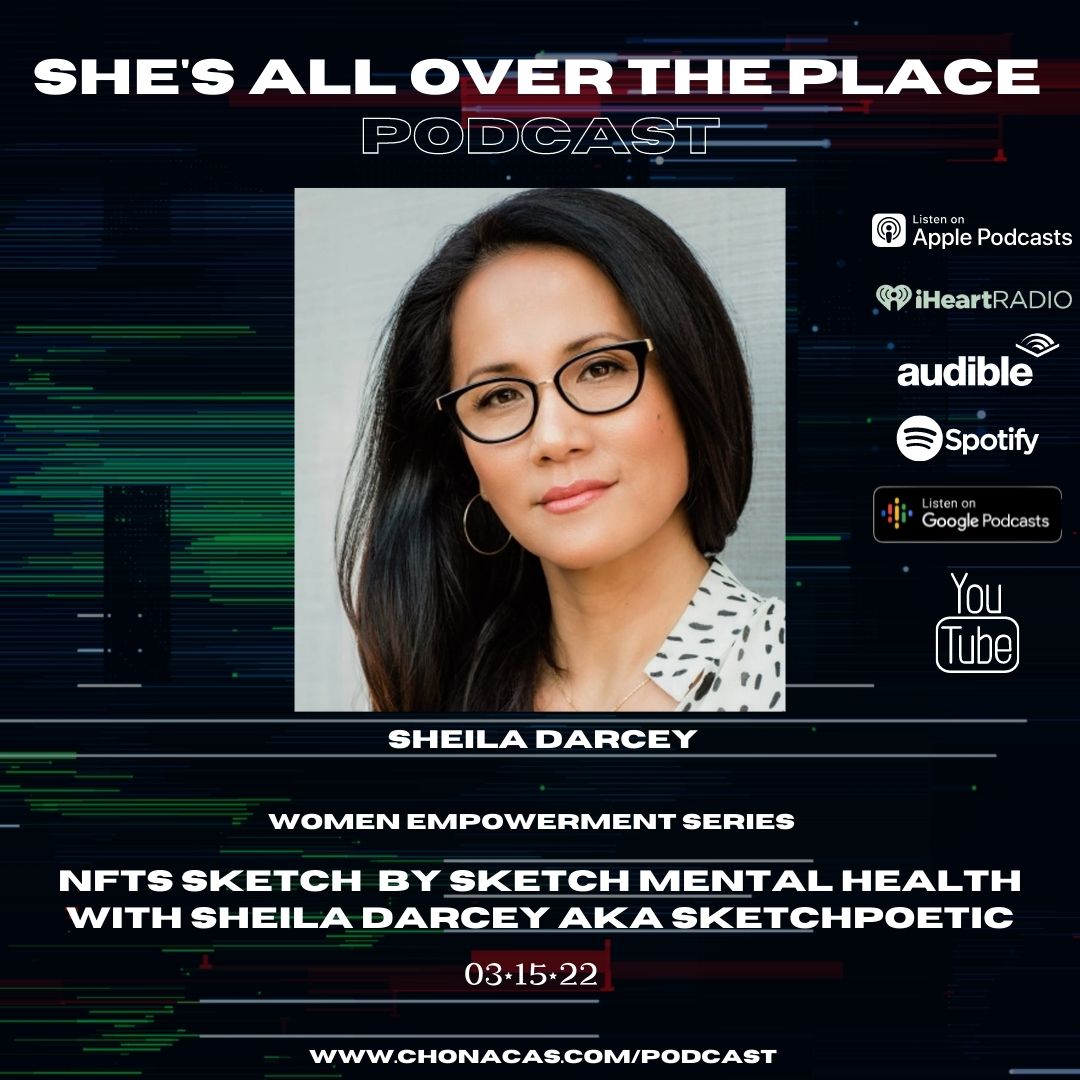
And today we have an NFT artist on Sheila Darcy and she goes by sketch poetic. And she's amazing. She's doing brilliant work in the space with community and who she is, what she stands for. So we're going to have an exciting conversation, Sheila. Thank you so much for joining me. How are you?
I am great. I'm already feeling your vibe.
Yes.
I love it. It's the best buy bedroom.
Amen. Thank you. I feel that it must be the west coast son in love. I'm just going to dive in real deep because people are going to find out we're going to talk about it later. You have a new book. Can you share your book with us?
Yeah. So the book is out, it's called sketch by sketch a creative path to emotional healing and transformation. And I call it a love child between three books, the artist's way surrender experiment and how the body keeps score, because it talks about the mind body spirit connection. And it's really a promoting art or creative expression as a way to heal and work through our emotions and feel them.
I've read the first two books. The third one I haven't read yet. So I'll have to read that one.
Yeah, it's amazing. It's best by Bessel VanDerKolk and it's really about, and this is something that was new to me, Katie, all of this was super far on, it just started happening when I started sketching daily. But it's really about understanding how much your body stores in terms of emotions and trauma and experiences and my entire life. I wasn't aware of it. Not only not aware, but it's not something we talked about. Mental health was not something we discussed in my home at all.
Yeah. So when I was a kid, I know exactly what you mean when I was a kid. My number one thing. When I was in career decision making class, they put a hundred words on the board, literally one through a hundred and out of the hundred, you had to put 20 and out of the 20, I categorize them. What was most important? And I said health, because if you had your health, you had everything else. And if I had my health, I had everything on the page and everything on the board, I was thinking physical health. I wasn't thinking mental health.
Well, first of all, how wise are you that you notice that? But secondly, I do hope one day and this is my vision for the future is that we talk about holistic health. When we say health is even now as I become more of a mental health advocate, I don't think I can represent mental health without talking about the body and the emotions and all those things. And so that's the reason I feel the book is going to resonate with so many people because I don't talk about emotions is just emotions. They're all connected, even our spirit. And it's not necessarily a book that doubles down on the whole spiritual path and the journey, which is what happened to me. It really is accessible because art is accessible. It's available to everyone. It's just that sometimes we don't connect the deeper, more meaningful resonance, I guess is the word I keep on using.
But the deeper resonance in your heart and your soul that creating can do creativity is the closest thing to the highest power you can feel.
I want to say one thing, because with what you just said, you said art is available accessible to everyone on my birthday, 11, 11, this NFC gallery. They hosted my birthday party and I dropped my album dreamland 11, 11 on my birthday, on the blockchain on open. See, that's another conversation. But what I wanted to share was I was in a Lyft leaving and the woman who picked me up, she just got done from working out at the gym and she was, she was going to work till four or five in the morning. She was working one of those all-nighters and she was so sad and so depressed. And she was telling me how heavy and how sad and depressed she was. I'm coming out of this amazing gallery on Abbott, Kenny with all these people.
And she's like, what's going on in art show? And I'm like, yeah. And she said to me, it was so sad. She said to me, oh, I've never been to an art gallery. Yeah. So even though maybe someone's tuning in and we're saying arts accessible to everyone. And so I informed her in case someone's tuning in who doesn't know. And I shared with her, all the museums, all the galleries, you can go for free. And she's like, oh really? And I'm like, yeah, you just go online. They're open to the public. And they have like a public day and I don't know the rules with what's going on in the world, but that was so new to her. She didn't know. So I just wanted to kind of say that for someone who's tuning in who maybe like, what do you mean it's not accessible to me because for us, it is because we're immersed in it.
Some people may not be so attuned to it.
Well, I want to add to what you said, Katie. There's also not only the physical galleries and spaces where I, where in addition to what you just said, where I was going is that some of the most traumatized people and societies have little access to mental health resources. And not only because financially it can be expensive, right? Talk therapy is expensive. The geographical availability of some of those places aren't there. And then what most first, and then the reality is art is right in front of you. Like you can pick up a pen right now and start sketching. And a lot of people don't know the power of sketching to tap into that greater sense of self and inner peace, which is what I had been seeking my entire life. I didn't find it through sketching.
So I love that. You said that, I mean, accessibility is a huge part of why I'm such an advocate for it.
Love all of this, love it. And speaking of your whole entire life, let's go back to little Sheila, where are you from when to tell us your story and when you picked up, you know, and did your first sketch.
Yeah. I'll, I mean, obviously whenever you talk about your, your history, you can go all over the place, but I'm going to touch upon the key ages in which this book matters to me. And I hope it really speaks to your audience, but I I'm immigrated from the Philippines to Australia. When I got there, I was around four or five, there was a lot of Asian sentiments. And so I grew up with lot of racism and bullying. In addition to that, I grew up in a domestic violence household and I'm only sharing these Nazi to just share my experiences. But the idea is simple between that and my culture of Asian culture. I grew up in an environment where I was super silent. Like I basically was silent because I was terrified of, you know, creating any tension or, you know, triggering my father.
I was silent because I felt a lot of shame. I was silent because that was part of my upbringing. So there was a lot of silence in my trauma, but what's really interesting. Katie is I was so uncomfortable with silence that always I needed to be around a lot in ways. Right. So that's why I was very frenetic. I was, you know, in a social butterfly it's because unconsciously, I didn't realize how much silence was causing me. A lot of discomfort. I grew up in Australia till I was about 15 and then I moved to Memphis and that was again, very racial. I wasn't used to just being in a school that was very black and white and there was only two Asians in my high school. So interestingly, I think the idea of race has been a thread throughout my entire upbringing. And then I started going down the corporate path.
I actually majored in art, but then got sucked into the corporate space because I really felt like I was living my life for everyone else. And so that's really a big part of my story. And
Where did you go to
School? I went to school in Memphis in terms of my college and high school. I went to Memphis and then in Australia was a place called Brisbane near Queensland for those.
Yeah. My heart is just so moved. I feel like I could just pour out and cry right now, but it's like, oh, I totally identify. And I understand what you mean about the silence and yeah,
It's such a common thing and it's outside of gender socioeconomic. What I sense is emotions are such a foundational connection we have as humans and how we disassociate from ourselves to survive. I don't think we realize how often we're in survival mode. That's the thing. Like I didn't even realize I was surviving. I just thought I was, I actually thought I was thriving. Ironically, I was surviving.
And did you realize you had space to get out of survival mode?
Well, that's the problem is, and I think this is a common story for so many of us. I didn't realize I hit a wall about six years ago. It was at the height of my corporate career. And I was like the managing director of an innovation agency. And I thought I had it all and I'm doing air quotes for those listening. I was very goal oriented Katie. And so every goal I hit and it just kept on here. And then I got to the point where I'm like, I'm not present. I clearly am not completely happy. I have an incredible life. So something's missing, there was something missing and it was really showing up in my fanaticism. I was just constantly on the go, always on. And like I said, outside, looking in everyone thought I was successful. And that's the kicker, the inner dissatisfaction and inner peace that was missing was inside of me.
I was really missing my art in my artistic self. I didn't notice sign of course, but that's what ended up happening
With something inside of you where you not giving yourself that you needed?
Yeah. I mean, part of my story and I share again, not to trigger anyone, but when I was 15, I started having just eating disorders. I started with anorexia and then became more bulemia and the reason I'm sharing that part of my story is that's actually how I was getting my emotions out. I didn't know it at the time, but it was a physical perch. Right. I was purging all the stuff that I needed out and it was, there was such a release in it. And then when I started thinking about when I got older, I'm like, what was the thing that I used to do that made me feel really good? And it was art. Like I remember as a kid, I would escape into my art and kind of to get where I was. Right. It was a way to safely feel like at home with myself, but none of this, there was no awareness of this for me, Katie, I just assumed art was this thing that we just talked about.
It needs to be in a gallery. It needs to be, it needs to look a certain way. People need to like it, you know? And I was such an, I'm such a perfectionist and people pleaser. And so there was all these elements that were really coloring my experience with art. And then on top of that, the perception we have of acceptance. So what makes you an artist? So I didn't even call myself an artist of two years ago.
Wow. Wow.
Wow. Right. Yeah.
Wow. Yeah. Same thing with the book. It's that applies to every principal. I think because when you're publishing a book, it's like, oh, is who's gonna like my work. Who's gonna, who's going to publish it. How do I decide who's gonna give me the most value, but now you can do self publishing. I published my poetry book. I'm a lover's fairytale. I'm going to send you a copy. You have to have it. And so are you self publishing your book?
No. This is the kicker. When I started sketch poetic, which is basically daily sketching and stuff about five almost five years ago, there'll be five years in April. I decided to sketch daily to express my emotions. And in the process of it, I took my business background, which is facilitating workshops. And I said, and I thought, I need to help people discover this. Like I genuinely couldn't believe what was happening to me. Like inner peace that I hadn't alluded my entire life. I started to find. And I thought this has gotta be something that other people need to be aware of. And then I started getting into books about it and research on neuroscience and the body. And so I got really well versed in the psychology and neuroscience and spirituality and all of that. And, but when I started doing the workshops, I noticed that I couldn't scale.
It's like I can't do enough work. And so when somebody, my writing partner, Rachel reached out to me said, have you ever thought of writing a book? I'm like, honestly, it's never been on my bucket list. However, I would love to help more people. So that's really where it came from that place of wanting to help more people.
So excited for your book. The answer
Is it got picked up by McMillan and hay house. So it's being published internationally. It's going to be a, you know, in UK and Europe and Asia and south America, it's going to be global launch, which is exciting.
Definitely, definitely. Wonderful. I love that. And then it'll so it'll be available everywhere.
Yeah. I think Africa right now is one of the few continents that unfortunately is not available, but you can order it and it'll, you can get it shipped to you. It's not easy. It's easy access, unfortunately.
Yeah. Okay, cool. And thank you for sharing everything. And so I'm wondering, how did you come up with the name? Sketch, poetic,
Easy. My coworker came up with it. So I started my Instagram account, Katie, and it was my first day at my work. So this is an interesting part of my story. I quit that job. I told you about when I was the managing director, because I knew that I needed to find a more well-balanced life. So when I started this new gig, I started sketching daily at this coffee shop verb on third street in Hollywood. And so I would go there every Monday through Friday and some of my cohort, I'm like, you know what? I need to start an Instagram account because I want to hold myself accountable. That's the only reason I started it. I'm like, I need a visual, like timestamp that I do it every day. And so we were bouncing off ideas and I said, you know, it's like, I'm sketching kind of free flowing. She's like sketch poetic. And I'm like, oh my God, that's brilliant.
So kudos to her. Name's Eliza Grover.
And it really is Eliza shout out to Eliza Grover. I mean, seriously, like it's super cool. The name. Yeah.
Poetic, poetic. It's perfect.
Yeah. I mean, by what you're saying, it's so inspirational because I definitely need a new journal right now and I desperately need a new journal and I do doodles with Sharpies. I love doing doodles and everything, but fine. If you're writing out words and you're journaling, it's, it's so cathartic. But also if people don't want to write, they can just sketch and doodle and get out your expressions through colors. That way to go on the emotional journey to get it out. Like you were saying earlier, it's so important because we have, everything's clogged so much clogged in here and just to get it out. And I know, you know, this time of these times in our lives, we, we definitely have a lot of things we've been purging, right?
Yes, absolutely. Well, and what I love about what you said is, you know, you've been doodling and you've also a writer. You and I are definitely not short of communication. Like we know how to articulate ourselves, right? The problem is sometimes you don't know how you're feeling or you're feeling too much. And the reason sketching has helped me is I don't have to put words into it. I just know that I'm expressing and releasing rather than trying to, this is the other part that why it worked for me. I had tried yoga. I had tried meditation and those practices for somebody that's going 150 miles an hour. It, it tells you, you quiet your mind. I'm like it was too big of a leap for me, Katie. I CA I couldn't go from 150 miles an hour to inner peace. Like it was just too big of a leap.
And what I love about my book and what I love about what sketchbook stands for is it tells you, it invites you to say, look, your thoughts are gonna are going to race. Your emotions are going to be felt, you know, you might be uncomfortable. Your body's going to do its thing. Maybe, you know, your nervous system may be shocked, but here's, here's the great thing. When you're sketching, you just need to observe all those things. You don't need to do anything with it. And, you know, as somebody like me, that's so performance driven, I think I'm supposed to do or act on everything that I'm feeling. And instead I just sketch and I'm just doing that. And when I'm sketching, I listen to what I'm hearing, you know, saying to myself, I'm, I'm watching my body react. That's the beauty of it is being a witness to it rather than trying to quiet yourself down.
Yeah. And then you made the beautiful connection that we're both M pass. And I talked about being an empath, you know, on the, on previous episodes, but for people who are tuning in, can you elaborate what an empath is for you? What that looks like? Well, yes, did a bit, but I mean a little more
And because I'm a visual person, I think of it as like a sponge, you know, when, when you are around somebody and you have such a desire to connect with them in a way that's authentic and real, we tend to take on what they were feeling, but instead of just taking it on our S our way of loving them, or certainly supporting them is to absorb it in it's, it's always taking the pain away in most cases or take, you know, or if they're feeling joyful to share in that joy. But if you're, if you're not aware of that, empathy is fantastic in terms of connection, but it may be hurting you if you're not taking care of yourself. So I'm learning more and more to be my husband. And he says, he's a therapist it's called equanimity is the ability to be empathic, but without absorbing it.
And so that's, that's why I sketch. It's like, okay, I just had a really heavy conversation with my daughter, let me sketch it and release it all so that it's not sitting in my body.
Yeah, definitely.
What's your definition?
Well, well, w one thing, well, absorbing definitely. So my, my, you know, my, my centers are open. Well, one thing I would like to say, like a tool that I do is if you know, I'm in a large crowd or an event or a party, or if I'm feeling something, a tool I do now that I didn't know before is I'll go to the bathroom and I'll run cool water on my wrist.
Oh, I love that because you're connecting with your body then. Right.
And then I'll, I'll, I'll, I'll put cool. Like I'll put cool water on my hands and then just put it on the back of my neck. I'll do it on my face. And that cools me down and it like dissipates the energy. Sometimes I'll need to sleep alone. You know, I, you know, I have been sleeping alone, but like, if I'm with a partner or something, maybe two nights out of the week, I'll just have to sleep alone because I'm picking up on their energy and I need to, I need to be with my own energy or else. I feel very frantic and I feel like the ocean going back and forth. So I need to be able to honor my space and be able to empty my cup.
So it's fresh in a new, in a, in a clear glass, because that's how I like to always be just very like, empty in a way. So I can be open to, you know, the creations.
Yeah. No, I love it. It's that duality of kind of extrovert introvert. Like I find myself energized in an introverted way, but I'm also by being an extrovert type of situation. So I do find that as I get older, though, I do find myself having more introverted moments. Yeah. I'm generally an extrovert, but yeah.
Yes. Most people think my whole life I'm an extrovert and I think I am an introvert, but I've learned to be an extrovert. I, I had a young age, I built those social skills. I built those schools cause I knew I had to. And then I learned the word ambivert where you could be both.
I think that's what I am and pervert. I
Lambert through your sketching. Everything is all about how you're feeling. Also. Do you have an idea? Do people commission you like, oh, I have this in mind. Are you open to those kinds of collaborations with people? Or do you just sketch basically from your experience in your feelings?
Yeah. It's a great question. So the answer is yes, I do. I love collaborations. So the underlying beauty of daily sketching was that it opened me up to connect with people in a different way. So one of the things I talk about in my book is it's great to sketch alone, but it's also important to have human connection. So what I do is I go through and I put this in the Q and a section, which is, if you're going to invite others to look at your sketches, or are you going to sketch with others? If you're an artist it's hard to get out of the art critic mode. Do you like my sketch type of mentality, even though you're asking them, like, what do you think of the sketch, your underlying saying, you're asking, do you like my sketch? So trying to get out of the habit of looking at art as art, but rather art as an expression of emotion, but at collaborations are great.
The interesting part of my journey, Katie, is that I didn't go into it wanting to become an artist. I always wanted to be an artist, but I didn't go into it thinking that that was going to happen. But it did for one singular reason, I was coming home to myself. I've always been an artist. I realized that now, since I was a little girl, I've always been an artist, but the label of it, the identity of it was so intimidating for me because I had all these societal expectations of what it means to be a fucking artist. Sorry. It's just makes me angry to think about it for myself, right? That little girl that just get it. You know what I mean? It's
Like, yeah, let's get it.
It was
Impure. It is.
And so I wrote this book for my 15 year old self to say, look, if you feel like art fits in this box of what a gallerist tells you or your art teachers told you or your parents have told you, that is so limited in what art is. And NFT space is really showcasing all of that, right? If you go to the rooms and the spaces that we're in, it's such a broad, oh my gosh, it touches on technology and innovation and storytelling and all of those things. But you know, we just have such a contained view of the world sometimes. And that's what happened with me. I know when a bit of a tangent there, but I get so impassioned when I think about how I viewed art in such a limited way.
Oh yeah, no, I have a, I have a lot of like teenagers who write me, who, who are tuning into the show. So it's this boy. One time wrote me. He said, I, his life, like he was thinking about like, I know. So when you were telling that story, I, it hasn't hit me in forever. But since you were telling me that story, I remember being in an art class one time and showing and doing that thing, showing my teacher and he just, you know, denied it. Like it wasn't good enough. And thank God I was who I was, because I didn't give a flying anything about what he said, because in my mind, I'm like rebel with a cause I'm like, oh, whatever. Cause I'm not like everyone else. I'm like, I think it's awesome or whatever.
But I had that, that fighter mentality in me, not everyone does, you know what I mean? So I'm glad you shared that story.
The one thing that has kept them connected to the world too. And so you're not only potentially damaging someone's view of art, especially the youth of today, but it could be the one thing that saves their life to a point. Right. And so you can, I don't, I just don't want to underscore that, given what we've been through COVID and there is an underlying sadness in the world with the youth of today. I, gosh, I heard it from an art teacher recently. She's been a teacher for 15 years and she said, this is the saddest group of students she's ever met. And it's because they're sitting in their emotions. So that's the one thing I would say, Katie, if your audience is listening, that is only young, you know, the younger side, you know, I always thought emotions were just about feelings, right? You've got to feel the emotions.
But what I didn't realize is I also had a really difficult time expressing certain emotions, anger being mine, because I saw such unhealthy expressions of anger as a child. I just never did. I never knew you could express anger in a healthy way. I just assumed it was violent or, you know, like it made me nervous. And so even in the business world, whenever people got angry, I didn't realize because this is all unconscious until I woke up to the idea of what I was doing. I didn't realize I was already being triggered by someone's anger because my childhood, but I didn't know Noah that way. And so I would get really quiet and I get really people pleasing. And so it's because the emotion was triggering me, but I didn't not, I didn't know any
Of this.
Well, I think the biggest power of art is it allows you to sit in ruminate and contemplate and just learn to be a critical thinker, which we need more of in the society. I think we're just, we're just so used to listening to content and consuming all this content without thinking, what do I believe that What does that naturally, when you start to look at your art that way you always ask these questions, what am I trying to say here? Is that really what I'm trying to say? You know, when you start to invite those conversations in
Yeah. Thank you for elaborating and sharing. It's very beautiful. Thank you.
Yeah. Your creator. We do this intuitively, this is the thing we do all of this intuitively. It's just being more outwardly present about it. Really?
Yeah. And this is a safe space to do that too, which is very exciting. So speaking of NFTs and to the person tuning in this is not financial advice. This is just sharing and caring in the community and kinships that we're creating and building together. So I would love to hear about your NST journey of when you were introduced to how long you've been in the space and I've seen your work on open. See, let's, let's talk about at all.
Yeah. I love this. We don't get to talk about NFTs that often, but in terms of a podcast, but I consider myself three things, a curator I collector, and a creator, and those are three very different ways to move through the space as you, as you know, but I'm also going to answer it in a philosophical, spiritual way. This is the part that I know got to spend a whole nother podcast on. I fundamentally believe we are being invited and have an opportunity to see all these systems being challenged. Financial systems are in the systems of art and how it's been perceived technology, you know, socioeconomic the way we way under represented people are able to be seen in space marketing, all of those things. And it is challenging creators to be their own marketers and storytellers and all of these things.
But I think not only is it challenging them, it's educating them. So what I'm seeing as a positive is I've never seen it so much education happening in a space around all of these systems that, I mean, in the past, I don't think a lot of people were exposed to these types of conversations. Right? And so it's a very accelerated, very intense. And then as an artist, I love that we're telling NFTE people, whatever, if it's music or whatever your medium of choice is, is that you have something to say and something to share. And guess what, there's a collector out there for you. Right. When I grew up, it had to be a gallery owner that was your collector or somebody that's really rich. Like these are the perceptions I had, but I'm collecting other artists. And now I'm a collector.
Yeah. I'm getting, I'm going to get some, buy some of your art too. I'm a collector as well, for sure.
Each other's work. And that's the beauty of the, you know, they, they're calling, you know, they call it decentralization, but honestly I just, it's open. It's open, you know, there's obviously some going to be pitfalls and it's going to be painful. And there's also these perceptions people have of what's happening, that aren't in the space. But you know, I do believe there is a much greater reason. We're all here. You know what I mean? And I would love to hear your thoughts on it.
Well, I know what you mean, and we're definitely gonna have you back on the podcast and talk about that whole other thing and focus on that. But I'm right with you. I'm, I'm a curator collector and an artist and it's empowering and I don't have to jump through 19 hoops waiting on the approval to find X, O XO and hope that I can meet them or they see my work. And I'm like, like this desperate artist where I can just create an empower myself and put it up there and with help with my friends, literally, you know, navigating the seed phrase and wallets and platforms and not having gas fees for the talent, which is amazing.
And then, and then collecting and really supporting the community, you know, and sharing and caring with one another. And in collaborations, you know, cause me, I grew up as a cross country runner, so cool. Yes. My dad was across crunchy runners. So I knew about short-term medium-term long-term goals. And what I do as an individual affects the whole like, cause we got a team score and our meet. So what I do as an, as an individual is a ripple effect. So it starts with me and then it goes to friends, family, community, and the rest of the world. So you'll love this little sound, a little story to, it's a big story, but I'll keep it short. When I was a kid in Michigan, I was sitting in front of the TV and children international came on and it said how I could help.
And I just picked up the phone and it was before everyone was adopting kids in Hollywood and everything like that. And it was just my intuitive hit. And I sponsored a girl named rental and era in the Philippines.
Amazing.
Yeah. She calls me mom, like to this day, I spot the only reason why I'm at Facebook is because of her. Cause she graduated from the program, but she was a kid like a really like a very like four and I was a kid and we were pen pals and I would sponsor her and she graduated from the program. So I thought, you know, by the power of, yes, I can energetically connect and help someone in the world and be an anchor in the world with someone I've never, ever met. So I have like a really big connection with the Philippines
That's right,
Exactly. Yeah, yeah. Yeah. So to be able to be a part of something, so macro is just really, really powerful. So
Yeah, no, I mean, like you said, we could talk about this for hours, but you know, you said the word approval, which is really, I think people have been seeking approval and this NMT space is really creating advocacy, you know, for, I think to be your own advocate is really hard if you don't know what you stand for and why I like to be in the space. And what I hope I represent is I stand for arts and healing, mental health and activism. And because I know what I stand for, that's how I show up in the space. And therefore I don't, I don't get swayed by all of the, you know, the energies that come and go and the ups and downs because I'm pretty comfortable and rooted in who I am. And that's what I hope my book does. It's what I hope this. Ultimately, what sketch will do for people is to feel really grounded in who they are,
Tell everyone the name of the book again and where they can find you.
So you can find [email protected] or sketch poetic on all socials. And you can buy the book at all. Online bookstores. I'm a huge advocate of local bookstores as well. But if you go to sketch poetic.com, I have all the links to get my book on and it's called sketch by sketch a creative path to emotional healing and transformation.
Cool. And then you're on Instagram. So
I'm on Instagram, Twitter, and I'm barely on Facebook, but I'm on there just because there's still people there, but a lot of us are on discord and all these other community and community. Oh my God. How did we miss that? That is the other big reason. I'm an NFT space is the community is incredible. If you know what, if you allow yourself to the ones that are there.
Yeah, definitely very cool. Very cool. Any last words of wisdom or anything you want to share being an artist, your journey in the NFP space?
Yes. I'm going to reiterate what I said earlier because I used to in the business world, you know, transformation is always this huge thing like transforming an image we have is the butterfly, you know, the cocoon. And that turns into a butterfly. The caterpillar, what I've come to learn, Katie is transformation is just coming home to who you've always been. It's a lot of deconditioning shedding of the skin, things that it's just letting go of, of things and narratives because you've questioned and challenge what you believe in that's transformation. So it's not always looking different or being different or evolving into something greater than yourself, which is what I think I thought transformation was, which is why I'm. So I was always so growth oriented and performance-based, I've realized that just being myself is a hard, but it holds me there.
There's nothing. There's nowhere else to hide once you know who you are, there was no hiding because you're so certain in that, but it was so much easier to hide so much easier to fit in all these levels. Right? And so that's my wisdom or nugget for people today, listening back home to yourself because you're fricking amazing.
I love that. Love that. Thank you. Thank you so much for sharing everything. It was such an honor to have you on Sheila. And I'm so excited that we collaborated and did this podcast and I'm looking forward to doing many more collaborations with you in the near future.
Me too. Thank you so much. And I'm looking forward to collaborating with you in person as well.
1000% everyone. You heard it here. First, get the book right now and check out the show notes and follow Sheila. Get the book and keep rocking and rolling. Be inspired. Live your best life. And if you have any questions, comments, or concerns, feel free to reach out to me. We'd love to hear from you. Imagine [email protected] follow my social media and we'll see you next week for the women empowerment series, exploring divine femininity. Thank you so much. Thank you so much for joining us. We'll see you next time over and out.
Check out the She’s All Over The Place Podcast! https://www.chonacas.com/podcast/
Dreamland 1111 Album – https://distrokid.com/hyperfollow/saintkyriaki/dreamland-1111
Dreamland 1111 Merch – https://www.redbubble.com/shop/ap/93662139?asc=u
Saint Kyriaki – Miracles go to Marz (Official Music Video) – https://youtu.be/XjZDlwNU0Ac
Saint Kyriaki – Dreamland 1111 (Official Music Video) – https://youtu.be/9IjNGcgVCmI
Katie’s “A Lover’s Fairytale” poetry book on Love
Website: https://www.aloversfairytale.com
Buy the book: http://bit.ly/amzn-ALFTbook
Buy merch here: http://bit.ly/ALFT-merch
Katie Chonacas Socials
Tiktok: https://www.tiktok.com/@chonacas
Spotify: https://open.spotify.com/artist/2iTpKMr57KoIqdp92xLQb7?si=5Hi9uIcnSxe05XrpNtDL8w
LinkedIn: https://www.linkedin.com/in/katiechonacas/
Facebook: https://www.facebook.com/KyriakiChonacas
Instagram: https://www.instagram.com/chonacas/
Twitter: https://twitter.com/katiechonacas
Patreon: https://www.patreon.com/chonacas
Youtube: https://bit.ly/youtube-KatieChonacas
IMDB: https://imdb.to/3b2OQG3
OpenSea NFT Artist: https://opensea.io/chonacas